






What we know so far
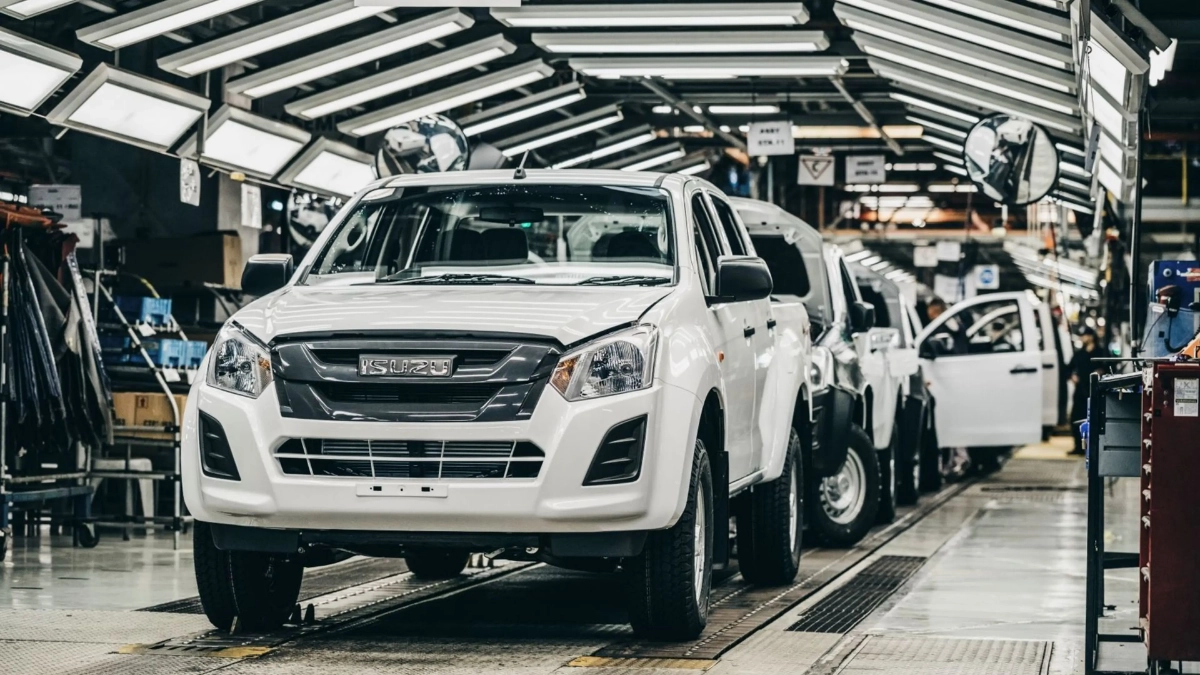
Isuzu Motors South Africa (IMSAf) has broken its annual local production record at the Struandale manufacturing plant in Gqeberha. During the company’s financial year ended 31 March 2026, production volumes for both the D-Max bakkie and Isuzu Trucks increased by 21% compared to the previous year, according to the company.
The record-breaking year saw 27,400 D-Max bakkies roll off the Struandale production line over 12 months, alongside 3,800 trucks. These vehicles were manufactured for both the domestic market and customers across the rest of Africa.
The production milestone coincided with a strong sales performance. In March 2026, the D-Max overtook the Ford Ranger to become South Africa’s second best-selling bakkie, with over 3,000 units sold during the month. Isuzu as a brand climbed three places to finish fourth overall in the country’s new-vehicle sales rankings, recording 3,513 total unit sales in March, according to data from naamsa, the Automotive Business Council.
Dominic Rimmer, Executive Vice President for Manufacturing and Product Engineering at IMSAf, attributed the result to sustained discipline and workforce commitment. He said the financial year’s success was built on the collective effort, skills, and commitment of the IMSAf workforce, supported by strong operational systems.
Why it matters
The record positions Isuzu’s Eastern Cape plant as an increasingly significant force in South Africa’s automotive manufacturing sector, at a time when the broader industry is experiencing a sustained domestic sales recovery but facing mounting headwinds from rising fuel costs and geopolitical uncertainty.
South Africa’s new-vehicle market recorded its strongest March in nearly two decades in 2026, with total domestic sales reaching 58,060 units, a 17.3% year-on-year increase, according to naamsa. This marked the industry’s 18th consecutive month of year-on-year growth. The performance was supported by improved consumer and business confidence and the lagged benefits of cumulative interest rate reductions earlier in the cycle.
Isuzu’s surge was among the most notable individual brand performances within that broader market upswing. The company’s March sales of 3,513 units represented a 48.2% increase over February, which itself was 47.6% higher than January. For the first time in recent memory, the brand breached the 3,000-unit mark in a single month.
The production record also reinforces the Eastern Cape’s role as an automotive manufacturing hub. Isuzu is one of the province’s largest industrial employers, with the Struandale plant directly employing more than 1,000 workers and supporting approximately 24,000 indirect jobs across the value chain.
Key details and figures
The production figures break down as follows for IMSAf’s financial year ended 31 March 2026: 27,400 D-Max bakkies produced (up 21% year on year) and 3,800 trucks produced during the same period. Combined, this represents the highest annual output from the Struandale plant on record.
Isuzu also retained its position as South Africa’s top-selling medium- and heavy-commercial vehicle brand for the 13th consecutive year, a streak the company says is underpinned by product strategy, vehicle durability, aftersales support, and long-standing customer partnerships.
The record volumes are the product of sustained capital investment. In 2019, Isuzu Motors Limited invested R1.2 billion in the South African operation to prepare for seventh-generation D-Max production. That investment funded extensive building expansion, updated tools and equipment, and the refurbishment and extension of the factory’s manufacturing line. Production of the new-generation D-Max commenced in 2022.
More recently, Isuzu invested over R260 million in upgrading its operations alongside VSL Manufacturing, its local panel manufacturing partner. VSL has built a R750-million purpose-built laser-cutting facility adjacent to the Isuzu assembly plant in Struandale, which produces body components for the D-Max range.
VSL Manufacturing Director Vuyo Skweyiya said the facility represented years of rebuilding and restoring jobs, and demonstrated that South African suppliers can compete at the highest level of global automotive manufacturing. He noted that Isuzu transferred tools, opened its supply chain, and worked closely with VSL to help the company meet demanding global standards.
Billy Tom, President of Isuzu Motors South Africa, framed the investment strategy in continental terms. He said Isuzu is positioning itself for the economic growth of the African continent and building local capabilities that enable the Gqeberha operations to serve as an automotive manufacturing hub for the region.
In the broader domestic market, naamsa data for March 2026 showed Toyota leading with 13,232 units, followed by Volkswagen Group Africa at 5,574 units and Suzuki at 5,047. Isuzu’s fourth-place finish at 3,513 units placed it ahead of Hyundai (3,258), Ford (2,828), and GWM (2,777).
What happens next
The domestic sales environment faces significant near-term pressure. From 1 April 2026, petrol prices increased by R3.06 per litre and diesel by between R7.37 and R7.51 per litre, driven by higher global oil prices linked to conflict in the Middle East and rand depreciation. A temporary R3.00 per litre reduction in the general fuel levy provides some relief but is due to expire on 5 May 2026.
Naamsa has cautioned that the external environment has shifted materially, introducing new risks that will likely shape demand conditions in the months ahead. The rand has depreciated by approximately 7.3% since February, which may feed through to vehicle price inflation.
Isuzu confirmed earlier this year that it plans to launch a new D-Max and next-generation truck range in 2026. The company has not disclosed specific timing or pricing for the new models, but media at the February 2026 IMSAf Address in Gqeberha were given a preview of the new D-Max.
Whether Isuzu can sustain its production momentum will depend partly on how the broader economy absorbs the fuel price shock and whether domestic consumer confidence holds. Brandon Cohen, chairperson of the National Automobile Dealers’ Association (NADA), said the strong March figures came partly because consumers were more comfortable with the interest rate remaining unchanged and government intervening to soften the blow of record fuel price increases.
The export environment remains challenging. Vehicle exports from South Africa fell 5.3% year on year in March 2026 to 37,388 units, with naamsa pointing to structural headwinds from heightened protectionism across key export markets.