






What SAPS has confirmed about the Kempton Park murders
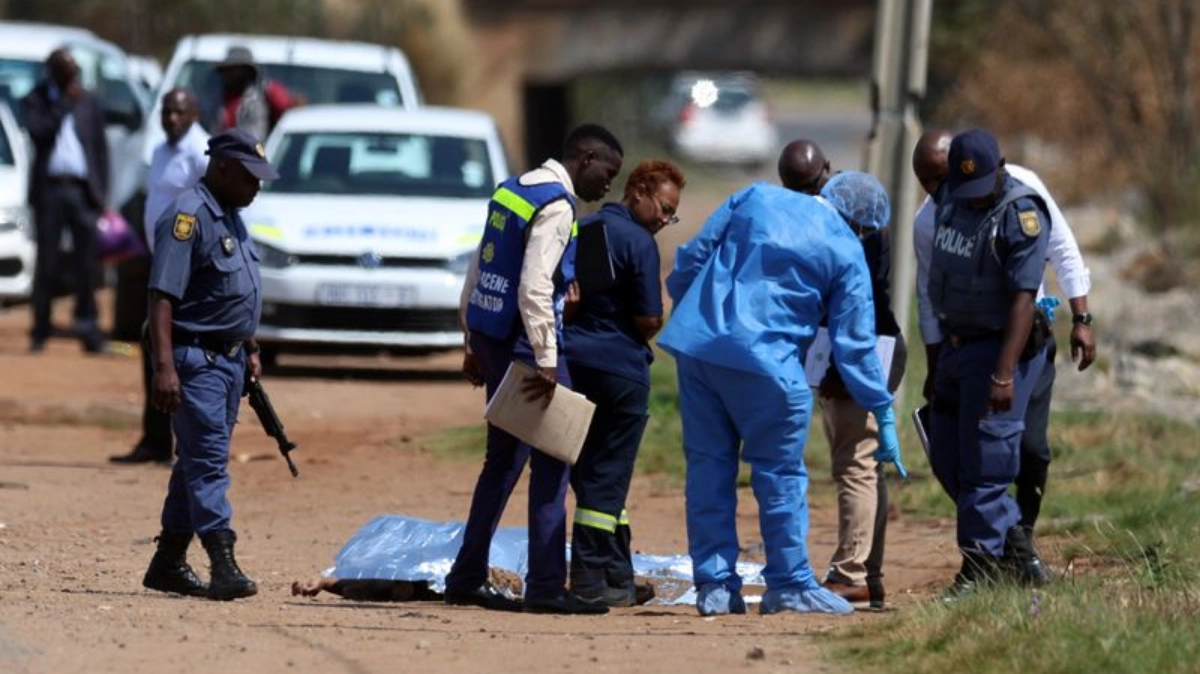
The South African Police Service is investigating the deaths of five women whose bodies were found in and around Kempton Park, Rhodesfield and Olifantsfontein in Ekurhuleni between mid-July and 14 September. A dedicated multidisciplinary task team has been established, and police have not confirmed that the deaths are the work of one person.
For women living, working or exercising in those suburbs, the immediate instruction from police is specific. SAPS has urged women not to walk or run alone, particularly in isolated areas, to avoid secluded spaces and to exercise in groups where possible.
Acting National Commissioner Lieutenant General Puleng Dimpane directed the Gauteng Provincial Commissioner to establish the task team. It draws on the Murder and Robbery Unit, the Investigative Psychology Unit, forensic specialists, tracking teams and K9 units, and is led by Gauteng Deputy Provincial Commissioner Major General Mbuso Khumalo.
National police spokesperson Brigadier Athlenda Mathe said detectives had identified similarities in the circumstances. The women were found partly clothed with visible bruising, and the discovery sites lie within the same general vicinity. SAPS said in its weekend statement that the similarities were “sufficiently concerning” to warrant a public warning and an intensified investigation, while stopping short of confirming a serial offender.
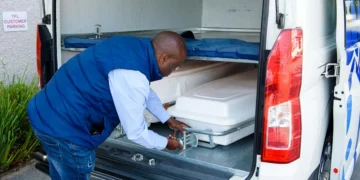
The Gauteng Department of Health has since confirmed the count. Departmental spokesperson Steve Mabona said five female bodies from the Ekurhuleni area, found between July and September, are at the Germiston mortuary. Two have been identified by their families. Three have not, and DNA samples are being retrieved to support identification.
The five cases
| Case | When and where | What has been reported |
|---|---|---|
| First | 15 July 2026, open veld near the R21 | A 37-year-old woman, found naked and restrained with cable ties. A suspect was arrested on 17 July and remains in custody |
| Second | 24 August 2026, near the R21 | A 32-year-old woman, found half-clothed with visible bruising |
| Third | 10 September 2026, closer to Rhodesfield | An unidentified woman, found in an advanced state of decomposition |
| Fourth | 12 September 2026, Rhodesfield, behind a hotel | A 38-year-old woman in sports clothing. Identified by her family on 14 September as Elizabeth “Tsontso” Moselakgomo |
| Fifth | 14 September 2026, alongside the R21 near Olifantsfontein | A woman found partially clothed with bruising and serious injuries. Police believe she was left there between Sunday night and early Monday |
Why police are resisting the single-perpetrator conclusion
The first case is the one that has not travelled with the coverage. The 37-year-old found near the R21 on 15 July was naked and bound with cable ties, a detail that does not appear in the descriptions of the other four. A suspect, reported to be her partner, was arrested two days later and has been in custody since. Acting Gauteng provincial police commissioner Major General Fred Kekana has said investigators have made progress in that case, which appears to be handled separately from the four that followed.
Kekana has repeatedly declined to treat the cases as one matter. He said it would be premature to conclude that the cases are linked or involve one perpetrator, and that “Our responsibility is to establish the facts through evidence.”
Police have since gone further than caution. Mathe told the SABC that police do not currently believe a serial killer is operating in Kempton Park. The Citizen, citing sources close to the investigation, reported that detectives are examining whether the deaths could involve different perpetrators rather than a single person, and that the latest case prompted them to revisit earlier murders for connections they may have missed.
Not everyone accepts that reading. Criminologist Professor Nirmala Gopal has said the pattern across the women’s deaths is consistent with a single perpetrator. The task team’s own analysis, drawing on the Investigative Psychology Unit, is meant to settle the question on evidence rather than pattern recognition from outside.
The number going around is five, not six
A figure of six has circulated since Monday. It does not describe six women.
The Citizen reported that a Kempton Park station commander told a Monday meeting that six murders had been recorded in the area over roughly two months, and that at least two of those involved men believed to be unrelated to the deaths of the women. The figure is a station docket count, not a victim count for this investigation.
The arithmetic does not resolve cleanly either. Six murders less two men leaves four, not five, most likely because the Olifantsfontein discovery falls outside the Kempton Park station precinct. Southafriworld has asked SAPS to clarify the figure and will update this article when police respond. Until then, the confirmed number of women is five, on the Gauteng health department’s own mortuary count.
The runner, and the women still unnamed
Elizabeth “Tsontso” Moselakgomo, 38, left her Kempton Park home for her routine afternoon run on Wednesday 9 September and did not return. Her eight-year-old daughter raised the alarm when her mother missed her usual time. Her body was found on 12 September on York Street in Rhodesfield, alongside the R21, and her family identified her at the Germiston mortuary on Monday 14 September. Her uncle, Andries Moroka Matlala, has said the family will leave the question of whether the deaths are connected to police, and credited the child with raising the alarm.
Three of the five women have not been identified. Their families, if they are looking, do not yet know.
Deputy National Commissioner for Policing Lieutenant General Tebello Mosikili said on Monday that 17 women had been reported missing in the Kempton Park area since January, and that 13 had been located and reunited with their families. She said a woman kidnapped in Kempton Park on Sunday had also been found safe.
What the national numbers show, and what they do not
The latest quarterly crime statistics, covering April to June 2026, record 5,427 murders in South Africa, a 5.9% decrease on the same period a year earlier. Within that figure, 569 women were murdered and another 1,052 survived attempted murder. Of 9,201 rape cases recorded in the quarter, 8,814 involved women and children.
A falling national murder rate does not establish that women are becoming safer, because a national indicator can improve while a particular group stays exposed.
The policy backdrop is weaker than it is usually described. On 21 November 2025 the head of the National Disaster Management Centre, Dr Bongani Sithole, classified gender-based violence and femicide as a national disaster under section 23 of the Disaster Management Act. The classification does not invoke emergency powers. It is routinely reported as a declaration, which overstates what it does.
That matters for what has followed. Gender-based violence researcher Lisa Vetten has said she has not seen new or additional funding reaching the shelters and victim-support services she works with in Gauteng, and that the number of shelters has declined since the classification.
Vetten has also documented that SAPS has published materially different figures for the number of women murdered in the same reporting period. For 2023/24, one SAPS presentation recorded 5,578 women murdered, the quarterly reports added up to 3,839, and the annual report recorded 3,485. The gap between the highest and lowest of those official figures is 2,093 women, a Southafriworld calculation from the three numbers Vetten cites. Similar discrepancies appeared in the previous reporting year.
Her point is that this is not a technical issue. Statistics determine how the state understands the violence, where it directs resources, and whether anything it does appears to be working.
What is being done on the ground
The City of Ekurhuleni activated its Joint Operations Centre on Monday 14 September. Spokesperson Phakamile Mbengashe said the centre, a multidepartmental operation led by the Ekurhuleni metropolitan police department, would act as a central communication point with SAPS, which retains responsibility for the criminal investigation. Mbengashe said the city would increase police visibility in Kempton Park and Rhodesfield, particularly in the morning when runners are usually out and in the late afternoon when people return from work.
Residents have not waited. Community members, with the Kempton Park Community Forum and the Girl2Woman Foundation, marched in Rhodesfield on Monday afternoon, where some questioned how police had communicated about the deaths. “We are scared as women of Kempton Park,” resident Nosiphiwo Galada told Daily Maverick. A memorial of candles has been set up at the site where Moselakgomo was found.
SAPS has appealed to residents, motorists, security personnel and community members who saw suspicious activity in Rhodesfield or surrounding areas to come forward. Information can be given to Warrant Officer Elvis Manyike on 082 465 7249, or anonymously through the MySAPS App.
What is not known
No arrest has been announced in connection with the task team investigation. No suspect has been publicly identified, and no motive has been given. Whether the cases are linked to each other, and how many people are responsible, has not been established.
Three of the five women have not been identified. Post-mortem and forensic processes are continuing, and the task team has given no timeframe.
What SAPS has said it will do is bring the specialised units to bear and report as evidence allows. What the task team finds will be determined by that evidence rather than by the pattern the public can see from the outside.