






What changed on 10 September
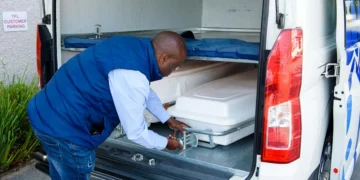
The repatriation of human remains into, out of or through South Africa now sits on the customs Prohibited and Restricted Imports and Exports list. SARS updated the list on 10 September 2026 at the request of the National Department of Health, which asked for human remains to be included for import, export and transit purposes.
SARS set out three requirements. A valid Human Remains Import, Export or Transit Permit issued by the National Department of Health is required for every consignment. Any accompanying health documentation required by the department must be presented. And all human remains must be detained for Port Health, under the Border Management Authority, and inspected on arrival, departure or transit. Clearance is granted only once compliance with the permit conditions and health requirements has been verified.
The underlying legal requirement is not new. Chapter 4 of the Regulations Relating to the Management of Human Remains, R.363 of 22 May 2013, already says nobody may import or export human remains without a permit from the Director-General of Health. What has changed is that the requirement now sits in the customs control list, so it is enforced at the border as a customs matter too.
Where to apply, and where not to
All permit applications go to the National Department of Health by email, at [email protected]. There are no walk-in submissions except in exceptional circumstances, and then only by prior appointment.
The critical point for families: no permit is issued at a point of entry. It must be in hand before the remains reach the border or the airport.
The department says a permit will be issued within at least two working days of receiving the application, provided every requirement is met. Applications should be sent only once, and only when all documents are available, because duplicates delay issuing.
Documents for an import permit
These are the documents the department requires when remains are being brought into South Africa.
| Document | Detail required |
|---|---|
| Cover letter from the embassy or funeral undertaker | Name of the deceased, place of burial, date and place of death, cause of death, the South African point of entry, and the type of transport |
| Death certificate | Must clearly state the cause of death |
| Identity document or passport of the deceased | Copy |
| Embalming certificate | Must state that the remains have been embalmed |
| Letter from a family member requesting importation | With contact details and a copy of their identity document or passport |
| Non-infectious or infectious disease certificate | Signed by registered medical personnel or a forensic pathologist |
| Certificate of Competence | For the funeral undertaker who will handle the remains in South Africa |
Documents for an export permit
Sending remains out of South Africa requires more, because two Home Affairs documents come into play.
| Document | Detail required |
|---|---|
| Cover letter from the embassy or funeral undertaker | Same details as for an import, with the point of exit and type of transport |
| Death certificate | Must clearly state the cause of death |
| Identity document or passport of the deceased | Or an affidavit from the South African Police Service where the deceased has no means of identification |
| Embalming certificate | Stamped with the details of the funeral undertaker and the embalmer, and reflecting the physical address where embalming was done |
| Letter from a family member requesting exportation | Granting the embassy or undertaker approval to process the transport, with contact details and identity document |
| Non-infectious or infectious disease certificate | Signed by registered medical personnel or a forensic pathologist |
| Notice of Death form BI 1663 | Issued in the death registration process |
| Burial Order | Issued by the Department of Home Affairs |
| Certificate of Competence | For the funeral undertaker or mortuary handling the remains in South Africa |
If documents are not in English, a certified translation must be attached. Where the deceased and the family member applying do not share a surname, an affidavit is required. If the person died on business and the employer is handling transport, a letter from the employer and a copy of the employer’s identity document must be included.
The embalming certificate has two versions
The wording on the embalming certificate is not a formality, and it differs by case.
For non-infectious remains, the certificate must state that the remains were embalmed, sealed in an airtight container and placed in a sturdy, non-transparent coffin.
For infectious remains, it must state that the remains were embalmed, placed in a polythene bag, sealed in an airtight container and placed in a sturdy, non-transparent container.
Where embalming cannot be done for religious reasons, the application must include a statement from the relevant authority setting out the alternative preservation method, and the department says this must be done immediately for infection control purposes.
Ashes are treated differently
No import or export permit is required for cremated remains. The death certificate, the cremation certificate and a copy of the deceased’s identification must accompany the ashes at all times during transport, and the ashes must be in a sealed airtight container placed in an urn.
A note on the two published lists
The SARS notice and the 2024 departmental guideline describe the paperwork in slightly different terms. SARS refers to burial, removal and cremation documentation, a letter from the embassy and a formal application letter to the Director-General for the permits. The departmental guideline lists a cover letter from the embassy or undertaker, the BI 1663 and the Burial Order. Work from the departmental checklist and confirm by email before submitting, because the permit is issued by Health, not by SARS.
Where a death also raises estate questions, our guides on what makes a will valid in South Africa and who inherits when there is no will set out the position, and Home Affairs services covers the death registration side.
Where to check
The National Department of Health issues these permits and publishes the requirements. Applications and queries go to [email protected], and the department lists office-hour contact numbers on the guideline document at www.health.gov.za. The customs position is on the SARS Prohibited and Restricted Imports and Exports list at www.sars.gov.za, updated on 10 September 2026.