








South Africa’s worsening jobs picture is bad news for domestic workers, even if the latest official labour release does not yet provide the clearest public quarter-by-quarter breakdown for the occupation in the sources reviewed. Reuters reported on Tuesday that South Africa’s official unemployment rate rose to 32.7% in the first quarter of 2026, up from 31.4% in the final quarter of 2025, as the number of employed people fell and the number of unemployed people rose.
That matters because domestic workers were already among the most vulnerable workers in the country before the latest labour shock. In November 2024, Statistics South Africa said domestic work remained one of the hardest-hit occupations after Covid-19, with employment still far below its pre-pandemic level. Stats SA put domestic-worker employment at 854,000 in the third quarter of 2024, which it said was 16.8% below the peak reached in the third quarter of 2019.
The stronger and more accurate angle here is not that South Africa has introduced a new law directly hurting domestic workers. It has not. The bad news is that an already fragile, often informal sector is entering a weaker labour market while many households remain under financial strain. At the same time, the statutory minimum wage has risen again, which improves protection for workers in law but also lands in an economy where many employers are already cutting costs.
What we know so far
Reuters reported that 345,000 jobs were lost in South Africa in the first quarter of 2026, while the number of unemployed people increased by 301,000. SABC’s same-day report on the Stats SA release also said the unemployment rate rose to 32.7% and confirmed that the first quarter brought a broad deterioration in the labour market.
What makes that especially worrying for domestic workers is the sector’s weak starting point. Stats SA’s dedicated analysis on domestic workers says employment in private households is a crucial but highly vulnerable part of the labour market. It says domestic work is largely informal, heavily concentrated among black African women, and still significantly below pre-pandemic levels despite the broader economic recovery seen in some other occupations.
Stats SA’s analysis also explains why domestic workers remain exposed during downturns. Many lack essential social protection, including unemployment benefits, and their jobs are directly tied to the spending capacity of private households. When household budgets tighten, domestic work is often one of the first categories to be reduced, scaled down or informalised. That vulnerability is built into the structure of the sector, not only into current economic conditions.
There has been one recent formal gain for the sector. Employment and Labour Minister Nomakhosazana Meth announced in February that the statutory national minimum wage would rise from R28.79 to R30.23 per ordinary hour worked from 1 March 2026, and said the increase would apply to all workers, including domestic workers. That raises the legal floor, but it does not guarantee compliance or stronger demand.
Why it matters
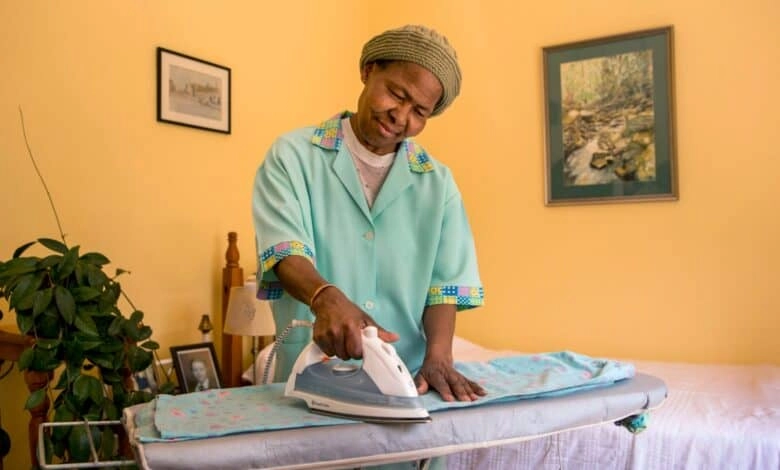
Domestic workers occupy a difficult position in South Africa’s labour system. Their work is essential to the care economy and to the functioning of many middle-class and working households, yet the occupation remains undervalued and often weakly protected. Stats SA says domestic workers provide vital services such as childcare, cleaning, cooking and elderly care, but many remain excluded from the kind of labour and social protections more common in formal employment.
That means a weaker labour market does not hit all workers in the same way. When a sector is already informal, low-paid and still recovering from a long post-pandemic slump, a broader rise in unemployment tends to deepen insecurity even if there is no single new policy aimed at that sector. This is an inference drawn from the combination of the Q1 2026 labour deterioration and Stats SA’s official description of domestic work as a fragile, still-unrecovered occupation.
The new minimum wage also creates a tension policymakers cannot ignore. On one hand, raising the legal minimum is meant to improve dignity and pay for vulnerable workers. On the other, higher labour costs can arrive at exactly the wrong moment for households that are already cutting discretionary spending. The Department of Employment and Labour’s February announcement is therefore good news for formal worker protections in principle, but it comes amid a worsening jobs environment that may limit how much of that protection is realised in practice.
Key details and figures
The most important current figure is the national unemployment rate of 32.7% in the first quarter of 2026, up from 31.4% in the previous quarter. Reuters reported that this was driven by a fall of 345,000 in the number of employed persons and an increase of 301,000 in the number of unemployed people. SABC similarly reported that the labour market deteriorated sharply in the quarter.
The most important domestic-worker benchmark is not from this week, but from Stats SA’s latest dedicated sector analysis. That analysis says domestic-worker employment stood at 854,000 in the third quarter of 2024, down 173,000 from the third quarter of 2019. Stats SA said that placed the occupation 16.8% below its pre-pandemic peak and marked it out as one of the slowest labour-market segments to recover after Covid-19.
The minimum wage figure is also central. The Employment and Labour Ministry said the national minimum wage rose to R30.23 per ordinary hour worked from 1 March 2026. For domestic workers who are paid lawfully and consistently, that creates a higher earnings floor. For workers in informal or irregular arrangements, the benefit depends heavily on enforcement and employer compliance.
Taken together, those numbers tell a clear story. Domestic workers are entering a tougher national jobs climate from a weak base, with employment in the occupation still well below where it stood before the pandemic and the broader labour market now moving in the wrong direction again. That is the most defensible reading of the current evidence.
What happens next
The next test is whether the broader labour-market deterioration spills more visibly into private households over the coming quarters. If household finances remain under pressure and unemployment stays elevated, domestic work is likely to remain exposed because of how dependent it is on discretionary or semi-discretionary household spending. This is an inference based on Stats SA’s structural analysis of the sector and the latest labour-market decline.
For now, the safest conclusion is narrow and factual. The current bad news for domestic workers is not a fresh law targeting them directly. It is that South Africa’s labour market has worsened again while domestic work remains one of the occupations that has still not fully recovered from the shock of the pandemic.