








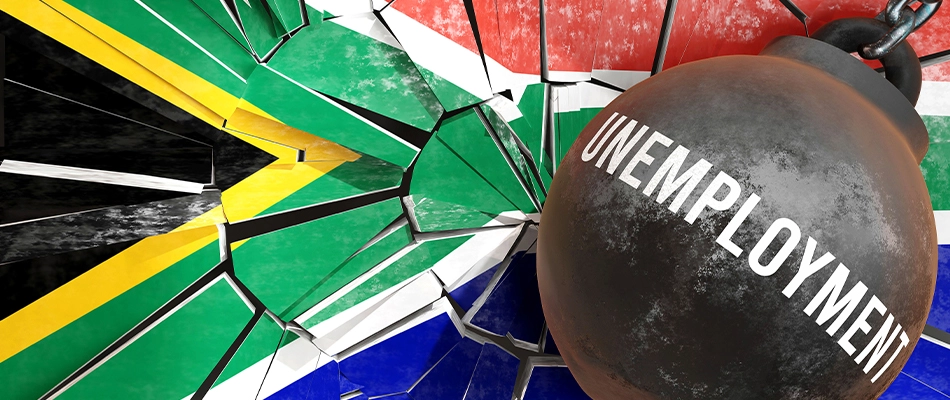
South Africa’s official unemployment rate rose to 32.7% in the first quarter of 2026, up from 31.4% in the final quarter of 2025, as the country’s labour market shed jobs and added more unemployed people. Statistics South Africa said 345,000 fewer people were employed in the quarter, while the number of unemployed people increased by 301,000 to 8.1 million.
That makes the latest labour release bad news for an economy already struggling to produce enough jobs for a growing working-age population. It also reinforces how fragile South Africa’s labour market remains, even when some sectors or shorter-term business indicators occasionally show improvement. Reuters reported that the new data added to pressure on the rand, underlining how closely labour market weakness is linked to broader economic confidence.
The stronger and more accurate angle here is not just that unemployment ticked up slightly. The official data show a broad deterioration in labour market conditions. Employment fell, discouraged job-seekers increased, the broader labour underutilisation measures worsened, and youth unemployment rose sharply. This was not a narrow one-sector setback. It was a significant first-quarter reversal.
What we know so far
Statistics South Africa’s Q1 2026 release shows that the official unemployment rate, known in the release as LU1, increased by 1.3 percentage points to 32.7%. The number of employed people fell to 16.8 million, while the number of unemployed people rose to 8.1 million. The labour force itself shrank slightly by 44,000, which means the employment picture weakened even before accounting for people who gave up actively looking for work.
The report also shows that pressure increased outside the narrow official unemployment definition. Discouraged job-seekers rose by 178,000 to 3.9 million, while the broader potential labour force rose by 240,000 to 4.9 million. Persons outside the labour force increased by 164,000 to 17.3 million. These figures matter because they show that the stress in the labour market extends beyond the headline unemployment rate alone.
Stats SA’s additional labour underutilisation measures worsened too. The combined rate of unemployment and time-related underemployment rose to 35.9%, while the measure that combines unemployment with the potential labour force rose to 43.7%. The broadest composite underutilisation measure, LU4, stood at 46.3% in the first quarter. That means nearly half of the extended labour force was either unemployed, underemployed or only weakly attached to the labour market.
The sector and provincial picture was also uneven, but mostly negative. Formal sector employment fell by 189,000 and informal sector employment fell by 127,000. The largest job losses were recorded in community and social services, where 206,000 jobs were lost, followed by construction at 110,000 and transport at 30,000. Manufacturing, mining and agriculture recorded smaller gains, but not enough to offset the wider losses.
Why it matters
This matters because South Africa’s unemployment crisis is not a short-term political talking point. It is one of the country’s deepest structural problems, and the first quarter figures show how easily the labour market can slip backwards. When employment falls by hundreds of thousands in a single quarter, the effects are not confined to job seekers. They ripple into household income, debt pressure, consumer spending, tax collection, social support demand and long-term confidence in the economy.
The figures are especially troubling for young people. Stats SA said the number of unemployed youth aged 15 to 34 increased by 181,000 to 4.7 million, while employed youth decreased by 258,000 to 5.6 million. As a result, the youth unemployment rate rose by 2.0 percentage points to 45.8%. That means nearly half of young people in the labour force were unemployed in the first quarter, a level that continues to threaten long-term economic inclusion and social stability.
There is also a regional dimension that matters politically and economically. KwaZulu-Natal was the only province to record an increase in employment, and even that was modest at 6,000. The biggest losses were in North West, Gauteng, Mpumalanga, Eastern Cape and Limpopo. Gauteng’s decline is particularly significant because of its central role in the national economy. When employment falls sharply in the country’s biggest economic hub, the effects are felt well beyond one province.
The labour data also complicate any easy story about recovery. Some recent business indicators have shown isolated improvement, but the Q1 labour release suggests that those gains have not yet translated into sustained job creation at the scale South Africa needs. Reuters noted that the latest employment figures reinforced concern about the country’s economic health. In practice, that means growth without strong labour absorption remains a central weakness in the South African economy.
Key details and figures
The main number is the official unemployment rate of 32.7% in Q1 2026, up from 31.4% in Q4 2025. Stats SA says that increase was driven by a loss of 345,000 jobs and a rise of 301,000 in the number of unemployed people. Employment fell to 16.8 million and unemployment rose to 8.1 million.
The broader labour market picture is even harsher than the headline suggests. Discouraged job-seekers increased to 3.9 million. The broader potential labour force rose to 4.9 million. The broad underutilisation measures rose to 35.9%, 43.7% and 46.3% depending on the definition used. These are not marginal shifts. They point to a labour market under broad strain.
Youth figures remain among the most alarming in the release. Unemployed youth rose to 4.7 million, employed youth fell to 5.6 million, and the youth unemployment rate rose to 45.8%. That is one of the most important figures in the release because it highlights how much of the labour market crisis is concentrated among younger South Africans.
Industry-level results show how widespread the damage was. Community and social services lost 206,000 jobs, construction lost 110,000, and transport lost 30,000. The sectors that added jobs, namely manufacturing, mining and agriculture, did so on a much smaller scale. This pattern suggests that the quarter’s labour weakness was not driven by one isolated industry shock, but by broader weakness across major parts of the economy.
What happens next
The next test will be whether the second quarter shows any rebound in hiring or whether the first quarter decline marks the start of a longer deterioration. Policymakers and businesses will be watching closely to see whether sectors that still showed modest growth can absorb more workers, and whether job losses in major service and infrastructure-linked sectors stabilise. That is not guaranteed. The first quarter numbers show how quickly labour market weakness can deepen.
For financial markets and economic planners, the release is another warning that headline macro stability is not enough on its own. Reuters reported that the rand weakened after the labour data, showing how closely employment performance is tied to broader perceptions of economic momentum. A persistently weak labour market can undermine revenue, confidence and reform credibility even when other indicators are less negative.
For now, the safest editorial conclusion is narrow and factual. South Africa’s unemployment rate rose in the first quarter of 2026, and the official data show a broad weakening in labour market conditions. The headline rate worsened, employment fell, discouraged job-seeking increased, and youth unemployment moved higher. That is a serious setback for a country already carrying one of the world’s highest unemployment burdens.