




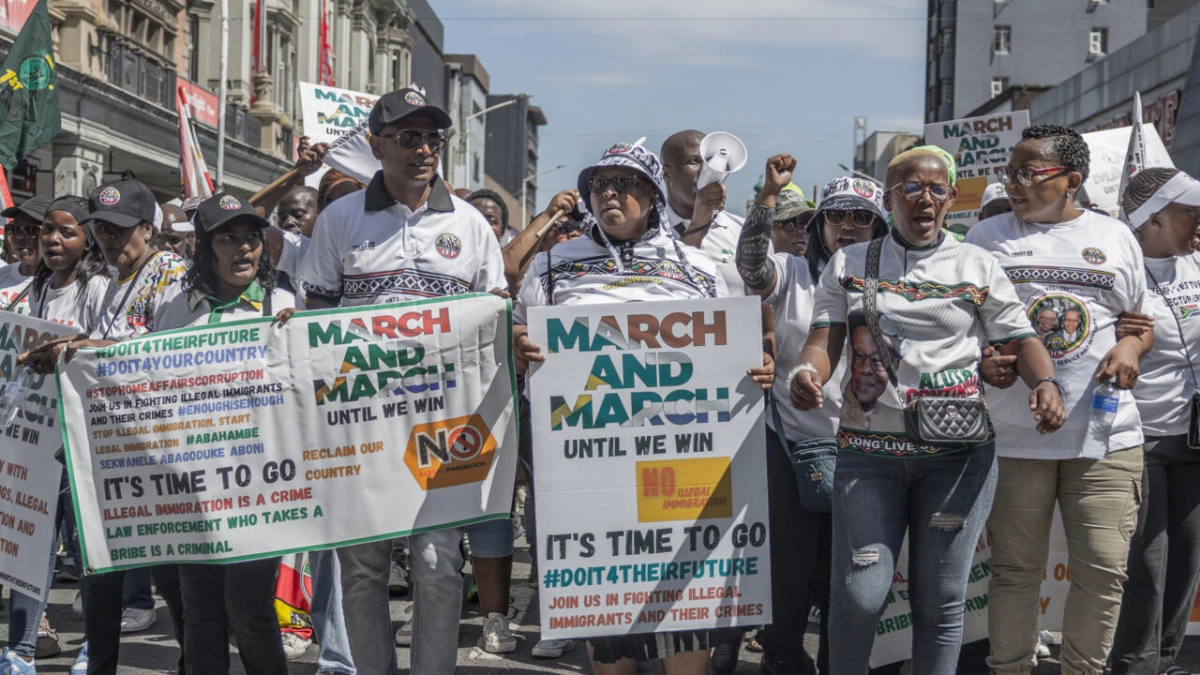
Ghana plans to evacuate 300 of its citizens from South Africa after a wave of anti-immigrant protests and violence targeting foreign nationals pushed the diplomatic fallout into a more serious phase. Reuters reported on 13 May that Ghana’s foreign minister said the citizens had registered for assistance with the Ghana High Commission in Pretoria.
Ghana says it is preparing to evacuate around 300 citizens who have asked for help. South Africa says it is acting against violence and rejects claims that viral material circulating online fairly represents the situation on the ground.
That matters because the issue has now moved well beyond isolated street-level intimidation. It has become a diplomatic problem involving multiple African governments, the African Union agenda, South Africa’s international standing, and questions about whether the state can contain anti-immigrant unrest without allowing it to spiral further.
What we know so far
Reuters reported that Ghana will evacuate 300 citizens from South Africa following attacks targeting migrants from other sub-Saharan African countries. The same report said those citizens had already registered for assistance through the Ghana High Commission. Reuters attributed the announcement to a post by Ghana’s foreign minister, Samuel Okudzeto Ablakwa.
This is not Ghana’s first formal response to the unrest. South Africa’s Department of International Relations and Cooperation said on 8 May that Ghana had requested a debate at the African Union Mid-Year Coordination Summit on what Ghana described as “xenophobic attacks” in South Africa against African nationals. DIRCO’s statement confirms that the issue had already escalated into an inter-state diplomatic matter before the evacuation announcement surfaced.
South Africa’s official position is more defensive and more qualified. In its 8 May response, DIRCO said there had been “sporadic incidents of confrontation” involving some immigrants and that the South African government had moved swiftly to condemn intimidation and direct law enforcement to protect citizens, residents and visitors. The statement also pushed back against Ghana’s framing by treating the matter as a broader law-and-order issue rather than accepting the label of a generalised national campaign of xenophobic violence.
President Cyril Ramaphosa struck a similar line in his weekly newsletter on 11 May. He said the recent violent protests and criminal acts directed at foreign nationals did not represent the views of South Africa’s people or government policy, and described the perpetrators as opportunists exploiting legitimate public grievances under the guise of activism. He also said such lawlessness would not be tolerated.
Cabinet has also tried to contain the narrative battle around the unrest. In its 7 May statement on the Cabinet meeting of 6 May, government condemned fake videos and images claiming to show attacks on foreign nationals in South Africa, saying the material was being used to inflame tensions and damage the country’s reputation internationally. At the same time, Cabinet said violence linked to protests over illegal immigration was unacceptable and had to be dealt with by law enforcement.
Why it matters
Ghana’s evacuation move matters because it turns a domestic South African security problem into a cross-border diplomatic incident with direct human consequences. Once a foreign government begins pulling citizens out, the story is no longer only about protests, political rhetoric or social-media panic. It becomes a judgment, whether temporary or symbolic, that the safety situation is serious enough to justify organised state intervention.
It also matters because Ghana is not acting in isolation. Reuters reported earlier that Kenya, Malawi, Lesotho and Zimbabwe had warned their citizens in South Africa to remain cautious and in some cases stay indoors as attacks on foreigners intensified. Nigeria, meanwhile, said at least 130 of its citizens had asked to be flown home under a voluntary repatriation process.
That regional response increases the pressure on South Africa’s government to show that it has control of the situation. Ramaphosa’s public message and DIRCO’s diplomatic response both suggest Pretoria is trying to walk a narrow line: acknowledging that illegal immigration is a real policy challenge, while rejecting vigilantism and pushing back against narratives that portray the country as endorsing attacks on African nationals.
There is also a political sensitivity inside South Africa itself. Cabinet has said South Africans are entitled to protest the country’s immigration problems, but that violence and intimidation cannot be allowed to ride on the back of those frustrations. That is a crucial distinction because the state is trying to avoid appearing blind to public anger over unemployment and illegal immigration while also preventing that anger from mutating into attacks on migrants and diplomatic damage across the continent.
Key details and figures
The central figure is 300. Reuters said that is the number of Ghanaian citizens registered for assistance and expected to be evacuated from South Africa. That makes Ghana’s planned response substantially larger than a symbolic single-family extraction or a routine consular advisory.
Another important figure is 130, the number of Nigerians Reuters previously said had asked to be repatriated from South Africa after similar anti-foreigner protests. Taken together, those numbers suggest that fears among foreign African communities in South Africa are not marginal or anecdotal. They are already producing organised consular responses.
The timing also matters. DIRCO’s 8 May statement came only days before Reuters reported Ghana’s planned evacuation, which suggests the diplomatic crisis has been moving quickly. South Africa was still trying to frame the events as sporadic incidents and to defend its handling of the issue even as another African state moved toward extracting hundreds of its own nationals.
It is equally important to be precise about what has and has not been officially established. South Africa’s government has condemned violence, but it has also said some viral videos claiming to depict attacks are fake. Ghana, by contrast, has pushed for AU-level discussion and now says it is preparing to remove citizens. The result is a public record that clearly supports a serious diplomatic and security dispute, but one in which the competing descriptions of scale and character still matter.
What happens next
The next immediate step is whether Ghana follows through with the evacuation and how quickly that process happens. Reuters reported the plan, but the pace, logistics and final number of departures may still depend on conditions on the ground and consular coordination.
On South Africa’s side, the government’s next test is credibility. Ramaphosa has said violent protests against foreign nationals do not reflect government policy, while DIRCO has insisted the state is acting against intimidation. Those assurances will now be judged against whether attacks are contained, whether foreign nationals feel safer, and whether other African governments stop escalating the matter diplomatically.
Ghana says it plans to evacuate 300 citizens from South Africa after anti-immigrant unrest and attacks on foreign nationals. South Africa says it is condemning the violence, rejecting fake viral content and enforcing the law. The issue has become a serious regional diplomatic problem.
Related: Ghana Orders Travel Warning on South Africa Over Xenophobic Attacks