




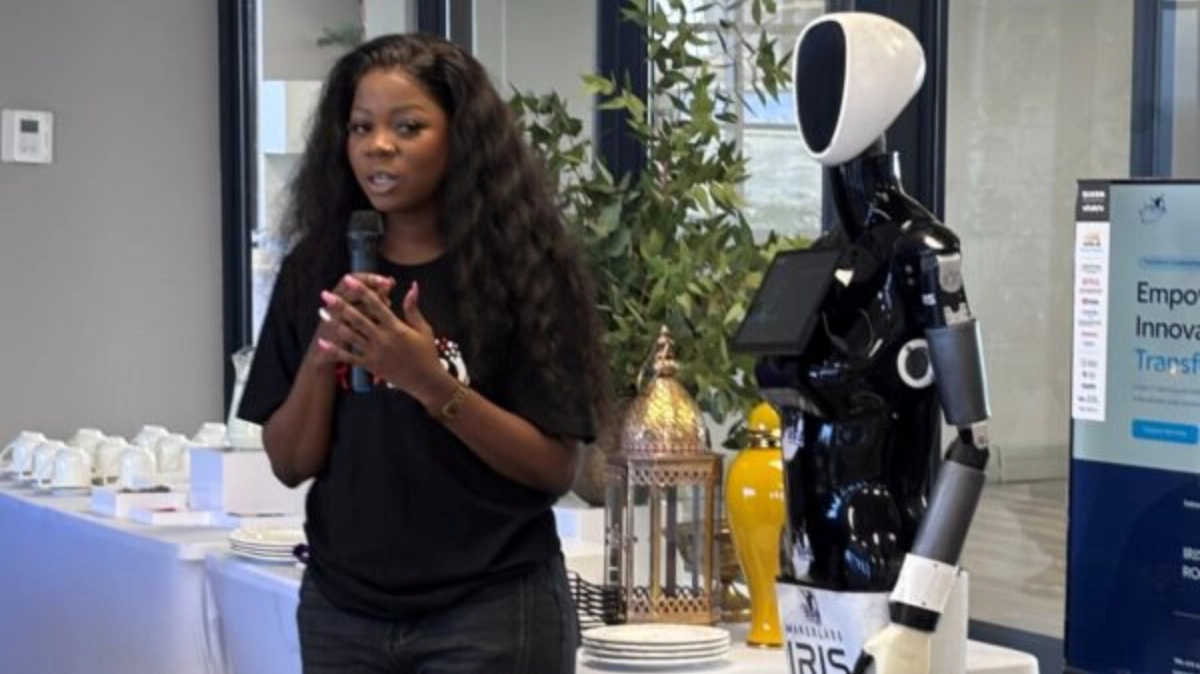
South Africa’s AI tutor robot is currently in five schools, and a facility to build it locally opened in Durban last week.
The figure travelling furthest, 23,000 schools, is the developer’s stated ambition rather than a signed agreement. No procurement process, funding allocation or deployment programme has been announced by the Department of Basic Education.
The robot is IRIS, developed by KwaZulu-Natal company BSG and Technologies. It is designed to answer learner questions, explain concepts, assist with assessments and analyse learner performance, and the company positions it as support for teachers rather than a replacement.
What happened on 13 August was a corporate milestone. BSG and Technologies opened a manufacturing plant and showroom at the Dube TradePort Special Economic Zone, moving IRIS from development into local production. Deputy Minister of Science, Technology and Innovation Dr Nomalungelo Gina welcomed the launch in a statement issued the following day.
What actually opened at Dube TradePort
The distinction matters, because several accounts have described the plant as a government launch.
It is a private facility inside a provincially owned special economic zone. The Department of Science, Technology and Innovation publicised and endorsed it, and Gina’s remarks were delivered on her behalf by Dr Anitha Ramsuran of the Technology Innovation Agency, a DSTI agency. Gina did not attend.
The showroom is the more immediate development. It gives schools, government departments, investors and communities a place to interact with the technology before committing to it.
Gina framed the localisation argument directly, asking “whether we will be consumers of technology developed elsewhere or producers” of technology designed for local problems.
That framing carries weight because the company says more than 2,000 IRIS units have been built internationally to date. The Durban plant is the attempt to bring that production home.
Dube TradePort Corporation chief executive Hamish Erskine said the zone’s investment in digital infrastructure, including local data centres and fibre, is what allows technology businesses to operate there efficiently.
What the AI tutor robot means for your child’s classroom
For almost every parent reading this, the honest answer is nothing yet.
Five schools have the technology under what the company calls the National IRIS Lab School Campaign. Private schools have placed orders. There is no public school rollout programme.
Where IRIS is deployed, the company says it teaches subjects aligned to the South African curriculum from Grade R through Grade 12 and into tertiary education, and can also work with independent school curricula.
It claims coverage of all 11 official South African spoken languages. That figure refers to the spoken languages only, because South African Sign Language became the country’s twelfth official language in 2023.
The company also claims IRIS can communicate in more than 7,000 languages globally. That is a vendor claim and has not been independently verified.
The design rests on natural language processing, emotion recognition and adaptive learning algorithms, and IRIS is integrated with the company’s own learning management system for progress tracking.
None of the material reviewed for this article discloses what a unit costs, which is the single number that determines whether any school outside a pilot can afford one.
The numbers behind the announcement
| Item | Detail |
|---|---|
| Robot | IRIS, developed by BSG and Technologies |
| Founder and CEO | Thando Gumede, former maths and physical science teacher |
| Company founded | 2017, as BSG Community Development |
| First public launch | August 2025, Durban |
| Plant and showroom opened | 13 August 2026, Dube TradePort |
| Schools with the technology now | Five, under the National IRIS Lab School Campaign |
| Company school target | About 23,000 public schools |
| Company job target | 20,000 over five years |
| Units built to date | More than 2,000, built internationally |
| Price per unit | Not disclosed |
The 20,000 jobs figure originates with the company. Gumede stated it at the launch as an aim covering manufacturing, technical support, training and the surrounding innovation ecosystem, and Gina then repeated it in the departmental statement as a potential outcome. It is a projection, not a commitment.
Gumede has described what building IRIS took. She taught herself to code after failing to secure funding to hire developers, and said “it took more than seven years of persistence, self-funding and continuous development” to reach manufacturing.
The teacher shortage this is being measured against
The context that gives the story its edge is not technological. It is staffing.
South Africa had 27,000 vacant teaching posts as of August 2026, according to figures from Basic Education Minister Siviwe Gwarube. More than 2,600 teaching positions had been frozen nationally as at 30 June 2026.
The Eastern Cape carries the heaviest load with more than 5,000 vacancies, followed by KwaZulu-Natal at 4,700 and Gauteng at more than 3,900.
Gumede and Gina have both been explicit that IRIS is meant to support teachers rather than replace them. The vacancy numbers are nonetheless the backdrop against which any classroom automation will be judged, and they are the reason the question gets asked.
The fiscal picture is equally relevant. When the DSTI tabled its 2026/27 annual performance plan in April, Gina told Parliament’s portfolio committee that the department was planning against a constrained national fiscal outlook, a decline in research and development spending as a share of GDP, and the withdrawal of United States funding from joint science projects.
A 23,000-school deployment would sit inside that environment. Southafriworld has previously reported on the difficulties government has had setting national policy for artificial intelligence, after a draft policy was withdrawn over fabricated academic citations.
Connectivity is the other precondition. The Competition Commission has linked affordable internet access directly to participation in education, and reported that internet price increases have stayed below headline inflation, while noting South Africa still ranked 31st out of 45 African countries for a monthly 1GB mobile package.
What has not been announced
The gap between the announcement and a national deployment is wide, and several things are missing from it.
No price per unit, no total cost of ownership and no funding model have been published. No Department of Basic Education procurement, budget line or policy position on classroom robots has been announced, and the department has not commented publicly on the 23,000-school figure.
The five lab schools have not been publicly named in the material reviewed. No independent evaluation of learning outcomes from those schools has been released, and international research on classroom robots generally reports strong engagement gains with more modest measured learning gains.
The plant’s production capacity, staffing and output timeline have not been disclosed, and the claim of more than 2,000 units built internationally has not been independently verified.
Gumede has set out the next phase as refining the technology, expanding adoption and demonstrating impact in real learning environments. That last step, evidence from classrooms, is the one that will determine whether the 23,000 figure ever becomes more than a target.