





Government and organised business have set a target of 1 million jobs, R3 trillion in investment and economic growth above 3% by 2030.
The same jobs and growth figures were set as stretch goals when Phase 2 of the partnership was launched in October 2024, with a deadline of the end of 2025. Neither was met.
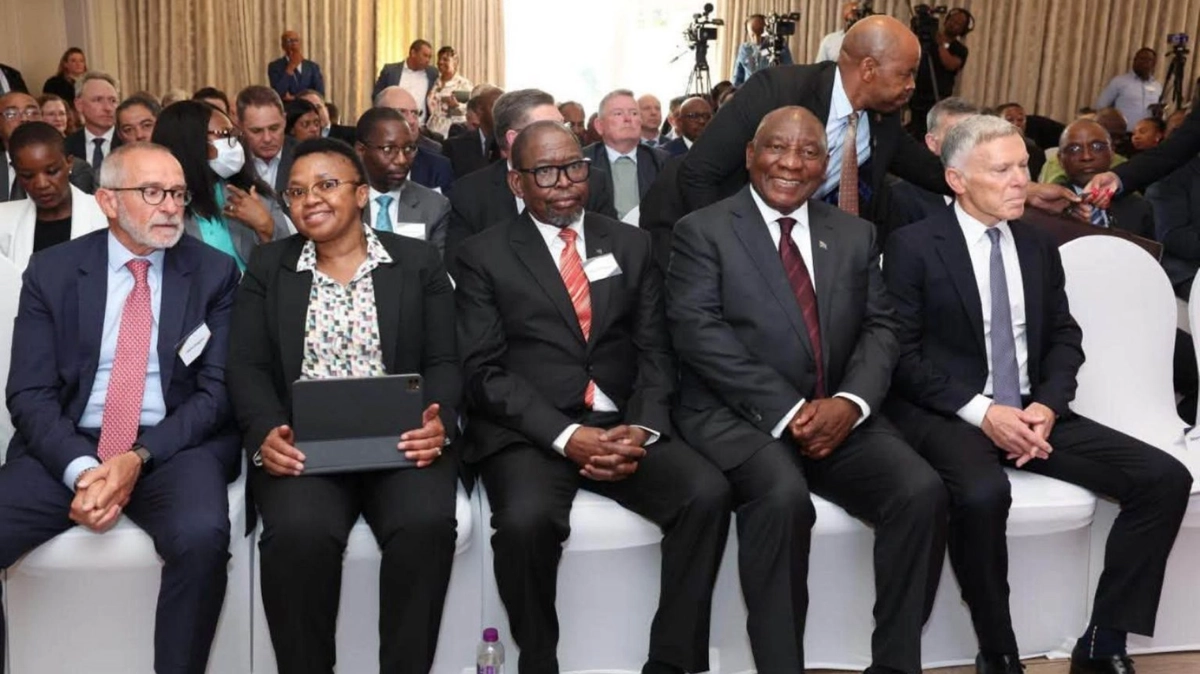
President Cyril Ramaphosa launched Phase 3 of the Government-Business Partnership at Summer Place in Hyde Park, Johannesburg, on Thursday, alongside Finance Minister Enoch Godongwana and Discovery group chief executive Adrian Gore.
The number that matters most for anyone out of work is the one Gore put on the table. Analysis presented to the partnership found that 3% growth would keep unemployment broadly flat. About 5% would be needed to make a material dent in the backlog.
What Phase 3 actually commits to
Phase Three formally commenced at a meeting in January under the framework “Inclusive Growth, Jobs and Confidence”. Thursday’s event was the public launch of the work programme, with the sectors and the numbers attached.
Four new work streams were added: infrastructure, mining, tourism, and agriculture with agro-processing. The existing streams on energy, logistics, crime and corruption, and youth employment continue.
Ramaphosa set out the sequence plainly. Phase One was about stabilisation, Phase Two about reform, and Phase Three must be about growth.
He also declined to treat the target as sufficient. In his prepared remarks he said the immediate objective is to lift growth above 3%, before adding that “growth of 3% cannot be the summit of our ambition”.
Godongwana made the same point from the fiscal side, describing 3% as a baseline rather than a ceiling. At current rates the economy is expanding more slowly than the population, which cuts income per person and adds to joblessness.
“When we grow at 3%, we will have better employment levels,” Godongwana said, before stressing that it is a minimum.
Why 3% growth will not cut the unemployment queue
The arithmetic is unforgiving, and it is worth setting out because the headline target invites a more optimistic reading than the underlying analysis supports.
South Africa’s official unemployment rate is 33.6%, with 8.5 million people out of work. That is higher than the 31.9% recorded in the third quarter of 2025, when Southafriworld reported the first meaningful improvement in the labour market in months.
About 300,000 people enter the labour market on a net basis every year, according to Gore. Over four years that is roughly 1.2 million new entrants.
A target of 1 million jobs by 2030 therefore does not clear the existing queue. On the partnership’s own analysis it runs slightly behind the flow of new entrants, which is precisely why 3% growth holds unemployment steady rather than reducing it.
Economic growth has averaged less than 1% a year over the past decade, which is the gap the plan has to close before any of this becomes relevant to a household.
The 1 million jobs target has been set before
This is the part of the story the launch material does not foreground.
| Target | Phase 2, set October 2024 | Phase 3, set August 2026 |
|---|---|---|
| Economic growth | 3% by the end of 2025 | Above 3% by 2030 |
| New jobs | 1 million by the end of 2025 | 1 million by 2030 |
| Investment | Not specified in this material | R3 trillion by 2030 |
| Outcome | Not met | Pending |
That does not mean Phase 2 achieved nothing. The verifiable gains are substantial and independently documented.
South Africa has gone more than a year without load shedding. Rail freight volumes and port performance have improved. The country exited the Financial Action Task Force grey list. S&P upgraded the sovereign credit rating for the first time in more than two decades, and Fitch has also upgraded. A sovereign Eurobond issuance was oversubscribed, the rand firmed, and inflation moved down towards the 3% target.
What did not happen is the conversion of those gains into growth and jobs, which is the entire premise of Phase 3.
Ramaphosa acknowledged as much, cautioning that the progress should not be mistaken for a finished reform agenda. “We cannot declare victory while critical reforms remain incomplete,” he said.
Where the growth is meant to come from
The four new sectors were chosen for their capacity to absorb labour and attract capital.
- Mining contributes about 6% of GDP and roughly 470,000 jobs. A mining cadastre, the digital licensing system the industry has waited years for, is targeted for March 2027.
- Tourism drew about 10.5 million visitors last year and contributes about 5% of GDP. The focus is air access, visa processing through an electronic travel authorisation system, and tourist safety.
- Agriculture and agro-processing work centres on value chains, market access, releasing state-owned land and issuing title deeds to farmers.
- Infrastructure underpins the rest. More than R2 trillion in private energy and infrastructure investment is already scheduled over the next decade.
Gore said South Africa’s mining, agriculture and tourism assets can support growth of 3% to 5% a year, while cautioning that the new work streams will take time to filter through to the economy.
The R3 trillion investment ambition, worth roughly $185 billion at current exchange rates, sits alongside individual commitments already announced, including Toyota’s R10.4 billion investment tied to the automotive energy transition.
It also has to be raised in a difficult external environment. South Africa is carrying elevated United States tariffs, and Washington has attached a set of policy conditions to improved commercial terms that the government has not moved on.
The disagreement over Eskom, and what comes next
The one open conflict at the launch concerned Eskom.
Eskom chairman Mteto Nyati warned that transferring the utility’s transmission assets to an independent operator could unsettle the company’s finances and trigger a backlash among investors.
Godongwana rejected the suggestion of indecision, saying there is no uncertainty within government about restructuring Eskom’s transmission business.
A comparable process is under way at Transnet, with National Treasury assessing the financial implications of separating rail infrastructure from freight operations.
Several fixed dates now sit against the plan. The South African Wholesale Electricity Market is targeted for early 2027, already delayed from an initial April 2026 date. Phase 3 aims to have six private train operating companies on the rail network during 2027. The mining cadastre is targeted for March 2027.
Much remains unresolved. No sector-by-sector breakdown of where the 1 million jobs are expected to come from has been published, no funding split between public and private capital has been set out for the R3 trillion figure, and no interim milestones have been given for the years between now and 2030.
Martin Kingston, executive chairman of Rothschild & Co’s South African operations and a partnership convenor, has also flagged local government as a constraint, telling Business Day that business needs a counterparty in city government that is competent, credible and has the authority to act.
The next hard test is the growth data itself. Stats SA publishes quarterly GDP figures, and the partnership has set no published checkpoint before 2030 against which progress can be measured.