







Four South Africans appear on Nepal’s preliminary missing list
Four South Africans are listed among the tourists unaccounted for after the Nepal floods that struck the country’s border with Tibet on Wednesday morning. The number has not been confirmed by the South African government.
It comes from a preliminary count issued by the Nepal Tourism Board, compiled from information supplied by tour operators rather than from immigration or consular records. Nepal Tourism Board spokesperson Sunil Sharma has been the source of the running nationality breakdowns.
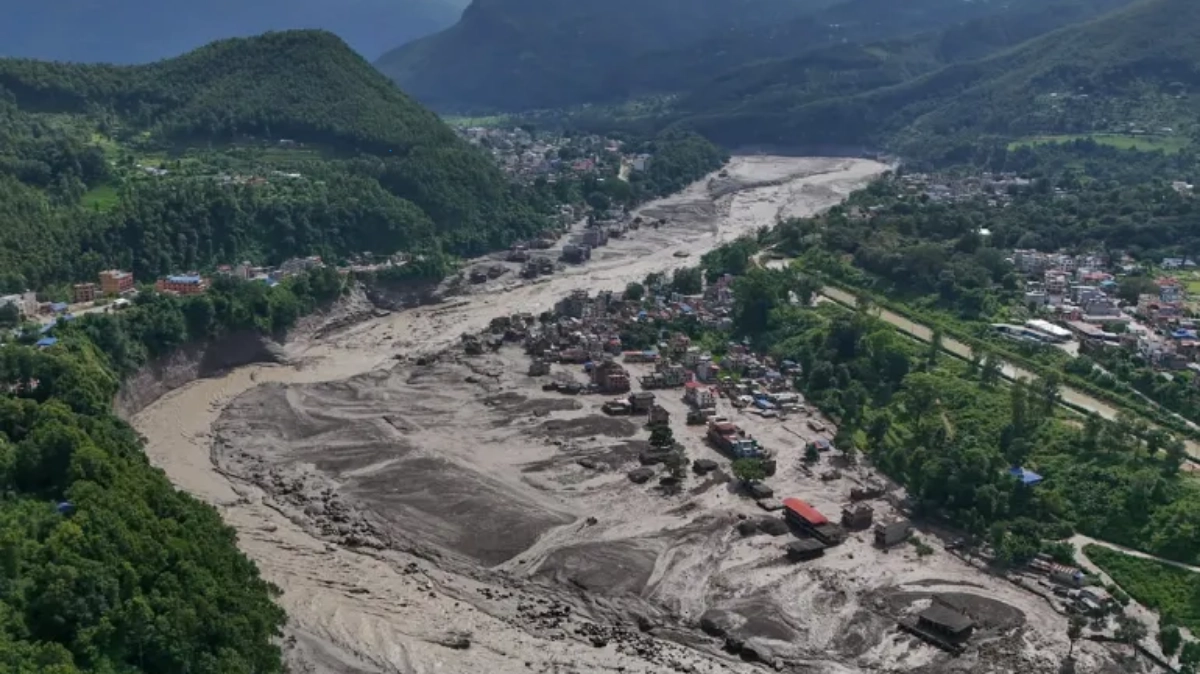
The disaster itself is not in doubt. A wall of water, mud and rock tore down the Bhote Koshi river valley at around 8:40am local time on 26 August 2026, sweeping through settlements in the Rasuwa and Nuwakot districts north of Kathmandu.
Reuters reported at least 157 people killed on the Nepali side by Wednesday evening, and CNN’s live coverage put the combined figure above 160. Nepal Police spokesman Abi Narayan Kafle had earlier confirmed 95 deaths and warned the toll would rise.
For South African readers the practical position is narrow and uncomfortable. Four citizens are on a list, no names have been released, and no South African official has spoken publicly about them.
Why the missing-tourist numbers keep changing
Two different Nepal Tourism Board breakdowns have circulated within roughly a day of each other, and they do not match.
| Detail | Earlier preliminary count | Later count |
|---|---|---|
| Total missing | 384 | 403 |
| Foreign nationals | 291 | 341 |
| Nepali citizens | 93 | Not stated |
| Indians | 105 | 133 |
| Americans | 3 | 47 |
| Britons | 12 | 33 |
| Australians | 1 | 34 |
| Canadians | Not listed | 24 |
| Malaysians | 17 | Not listed |
| South Africans | 4 | Not itemised |
| Dutch | 1 | Not listed |
The gaps are not marginal. The American figure moves from three to 47 and the Australian figure from one to 34, which indicates the earlier list was substantially incomplete rather than merely provisional.
The four South Africans appear only in the earlier of the two counts. Southafriworld has not located a later Tourism Board breakdown that itemises South African nationals, and Sharma has said people from at least 26 countries were present in the affected area with more than 100 missing travellers whose nationalities were still unconfirmed.
That does not mean the figure is wrong. It means it rests on a single preliminary source that has since been revised, and readers should treat it accordingly.
What South African families can do with no DIRCO statement
The Department of International Relations and Cooperation had not issued a public statement on the four citizens at the time of writing, and has not said whether consular officials are assisting.
Families seeking information can approach DIRCO’s consular services directorate directly. Southafriworld could not confirm that a dedicated helpline has been opened for this incident and has not published an unverified contact number.
The department has activated consular support for South Africans caught in overseas crises before, including assistance for South Africans leaving the Middle East and South Africans returning from the Russia and Ukraine war.
Communication with the worst-hit areas remains disrupted, which means a person listed as missing may simply be out of contact. Roads, bridges and power lines were destroyed across the valley.
What caused the Nepal floods
The trigger is not yet established, and scientists have cautioned that determining it will take weeks.
The United States Geological Survey initially logged shaking in the region as a magnitude 4.4 earthquake at 8:37am local time, then clarified that the signal came from the landslide itself rather than from a quake. A team of international scientists believes a large section of glacier sheared off a mountainside and fell into the Lhende Khola, a tributary of the Bhote Koshi.
The landslide appears to have blocked the river before releasing a surge downstream from China into Nepal.
There is a recent precedent on the same river. A flood in July 2025 killed nine people and washed away the Friendship Bridge linking Nepal and China, and the International Centre for Integrated Mountain Development in Kathmandu attributed it to the draining of a supraglacial lake north of the Langtang Himal range.
Tula Bahadur BK, a health worker in Rasuwa, told Reuters that (cite index=”53-1″>”There is devastation everywhere we look”,</cite> adding that riverside settlements had been swept away entirely and that five of his own relatives were missing.
What happens next
Search and rescue continues in poor conditions. District administrator Narendra Pariyar warned of heavy casualties and urged residents along the Bhote Koshi to move to higher ground, while army spokesperson Raja Ram Basnet said rescue helicopters would stay grounded in the affected zones until floodwaters subsided.
Three army helicopters turned back on Wednesday because of weather between Kathmandu and the flooded areas. Dozens of Nepal Police officers, army personnel and power utility workers involved in the response are themselves reported missing.
Across the border, China’s state media reported three deaths and 265 people missing in the Tibet Autonomous Region, with authorities deploying at least 574 rescuers to the Gyirong land crossing. Nepal’s Office of the Prime Minister expressed (cite index=”62-1″>”deep sorrow”</cite> and extended condolences to bereaved families.
Several things remain unconfirmed. The four South Africans have not been named, DIRCO has not verified the figure, the two Tourism Board counts conflict, the death toll is still rising, and the cause has not been formally determined.
Two things are expected to move first. Nepali officials hoped rescue flights would resume once weather allowed, and the Tourism Board is continuing to reconcile nationality lists with tour operators, which is the process that will either confirm or remove the South African entry.