








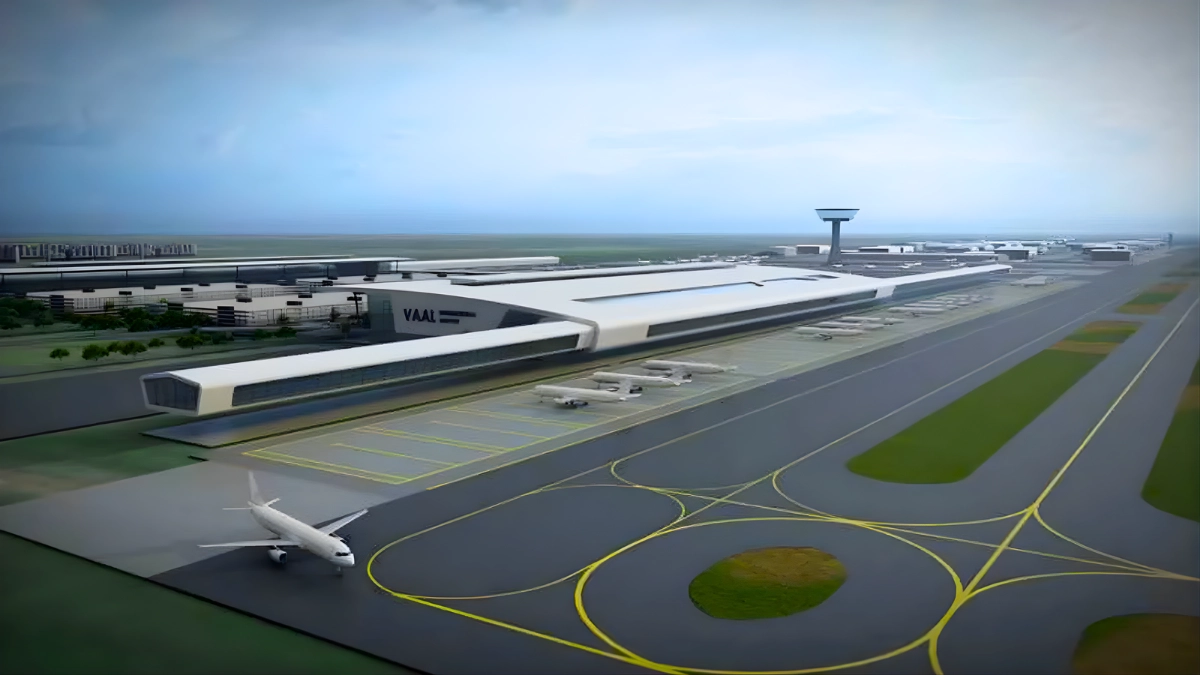
A new international airport is planned for Gauteng’s Sedibeng district as part of the proposed Vaal Special Economic Zone, a multi-sector industrial development currently under formal public consultation by the Department of Trade, Industry and Competition.
Minister of Trade, Industry and Competition Parks Tau published a 30-day public consultation notice on 3 March 2026, inviting stakeholders and the public to submit written comment on the proposed designation of the Vaal SEZ. The deadline for written submissions is 20 April 2026. The designation is being processed under Section 23 of the Special Economic Zones Act No 16 of 2014.
The Gauteng Provincial Government, through its Department of Finance and Economic Development, submitted the formal SEZ application to the DTIC in April 2025. The project is led by the Gauteng Growth and Development Agency, the province’s investment attraction and economic development arm.
What we know so far
The proposed SEZ covers 817 hectares spread across five land parcels in the Sedibeng District, identified in the Heidelberg, Rietspruit, Langlaagte, Zwartkopjies, and Kookfontein areas. All three local municipalities in the district, being Emfuleni, Lesedi, and Midvaal, are involved in the planning and designation process.
The DTIC has been hosting interactive public consultation sessions across the district. The first was held on 1 April at the Rathanda Multi-Purpose Centre, followed by a second on 8 April at the Meyerton Town Hall. A broader public engagement at the Vereeniging Civic Centre in the Sedibeng District is planned as the consultation period draws to a close before the 20 April deadline.
The airport is a central anchor of the wider SEZ plan. According to the Vaal Aerozone, the developer entity behind the airport component, the Vaal Aerotropolis is designed with an initial capacity of 7.2 million passengers and 150,000 tons of freight per annum. The developers describe it as the only planned airport in Gauteng where integrated air cargo services will be built as a core design priority from the outset, rather than added incrementally. The project has a stated road access advantage: the terminal site will have direct connection to the N1 highway, placing it within approximately 50 minutes of Johannesburg by road.
The SEZ is designed around multiple economic sectors. These include energy, with a focus on renewable energy components manufacturing and green hydrogen production, green steel manufacturing, agro-processing including cannabis processing, aerospace and aviation, electronics, and logistics. The DTIC’s own designation notice references a Trade Zone and Agri Zone linked to Heidelberg Airport as a formal component of the SEZ’s market sectors.
The DTIC has confirmed that the SEZ already has priority investors ready to break ground in the 2026/27 financial year, which the department described as a signal of genuine pre-investment pipeline depth.
Why it matters
The Vaal region, which includes the Sedibeng District, is one of Gauteng’s most economically distressed areas. Once anchored by the steel industry, it has experienced prolonged industrial contraction, population growth without matched employment creation, and infrastructure decay linked to chronic municipal underfunding. The Vaal River, which runs through the district, is among the most polluted in the country due to industrial discharge and raw sewage from surrounding infrastructure.
The DTIC’s economic projections for the proposed SEZ reflect the scale of what its planners believe the development could correct. Phase I of the project is expected to contribute R4 billion to GDP. Full development of the SEZ is projected to deliver R10.773 billion in GDP contribution. During the construction period in Phase I alone, the DTIC estimates the project will create approximately 4,302 direct jobs and 1,305 indirect jobs. A further 5,902 direct jobs are expected once the SEZ reaches its operational phase.
Gauteng already hosts two major airports: OR Tambo International Airport in Ekurhuleni, the busiest on the continent by passenger throughput, and Lanseria International Airport north of Johannesburg, which serves primarily low-cost domestic routes. Neither is located in the province’s southern corridor. A new international airport anchored in the Sedibeng District would be the first major aviation facility in that geographic corridor and would serve a region that currently has no scheduled international air access.
The SEZ’s green hydrogen component ties directly into the South African government’s broader national strategy. The cabinet-approved Green Hydrogen Commercialisation Strategy, adopted in October 2023, positions South Africa as a target global green hydrogen exporter. The Vaal SEZ is one of the designated investment locations intended to support that strategy in practice.
Key details and figures
The public comment deadline for the proposed Vaal SEZ designation is 20 April 2026. Written submissions must be sent to [email protected]. The gazette notice is available through the Government Printing Works at gpwonline.co.za.
The SEZ covers 817 hectares across the Sedibeng District, spanning the Emfuleni, Lesedi, and Midvaal local municipalities.
Phase I GDP contribution: R4 billion. Full development GDP contribution: R10.773 billion.
Phase I construction jobs: 4,302 direct and 1,305 indirect. Operational phase jobs: 5,902 direct.
The Vaal Aerotropolis is planned with an initial passenger capacity of 7.2 million per year and 150,000 tons of annual freight capacity, according to the Vaal Aerozone.
Priority investors have confirmed readiness to break ground in the 2026/27 financial year, according to the DTIC.
The project is being led by the Gauteng Growth and Development Agency, under the Special Economic Zones Act No 16 of 2014.
What happens next
The public comment period closes on 20 April 2026. Following the collection of submissions, the DTIC will process comments and the Minister will proceed with the formal designation decision. Until Minister Tau formally designates the SEZ, the project remains at the consultation and pre-designation stage. Formal designation is the legal step that enables the DTIC to begin operationalising the zone, attracting investment through SEZ incentives, and releasing infrastructure funding.
SEZ incentives available to businesses within a designated zone include tax breaks administered by SARS, subsidised interest rates through the Industrial Development Corporation, employment subsidies, training grants from the DTIC, and Eskom tariff discounts. The SEZ also operates as a customs-controlled area, which carries additional trade facilitation benefits for export-oriented manufacturers.
What the airport development timeline looks like beyond the SEZ designation is not yet confirmed in publicly available DTIC documents. The designation of the SEZ is a prerequisite for formal investment releases, which means the airport’s construction timeline will depend on when the designation is finalised, how quickly priority investors activate, and whether environmental and aviation regulatory approvals proceed in parallel. The Civil Aviation Authority has not issued any public statement regarding the aerotropolis at this stage.
The full development of the Vaal SEZ, including the aerotropolis, represents one of the most significant proposed infrastructure commitments in Gauteng’s southern corridor in a generation. Whether it reaches that scale will depend on what the public consultation surfaces, when the Minister issues his designation decision, and how quickly investor commitments behind the project are converted into construction.