


Ramaphosa points to outsiders behind anti-migrant protests
President Cyril Ramaphosa told MPs on Tuesday that people outside South Africa may be helping to drive the anti-migrant protests that have swept communities across the country this year. He did not say who they are.
He was answering questions for oral reply in the National Assembly on 25 August 2026, in a session Daily Maverick reports he attended virtually. The Presidency had said in advance that he would set out government efforts to stop migration-related actions from harming South Africa’s image.
Ramaphosa said government was “deciphering precisely the various roles that have been played by our own people, as well as those we perceive to be outsiders who want to disturb the stability in South Africa” by setting South Africans against Africans from other countries.
He was responding to questions from EFF leader Julius Malema and DA MP Ryan Smith. Ramaphosa did not identify the alleged outside actors or provide details of the evidence underpinning the claim.
That gap is the story. A sitting president has raised the possibility of foreign interference in domestic unrest without naming a country, an organisation or an individual.
What the claim means for communities where the protests happened
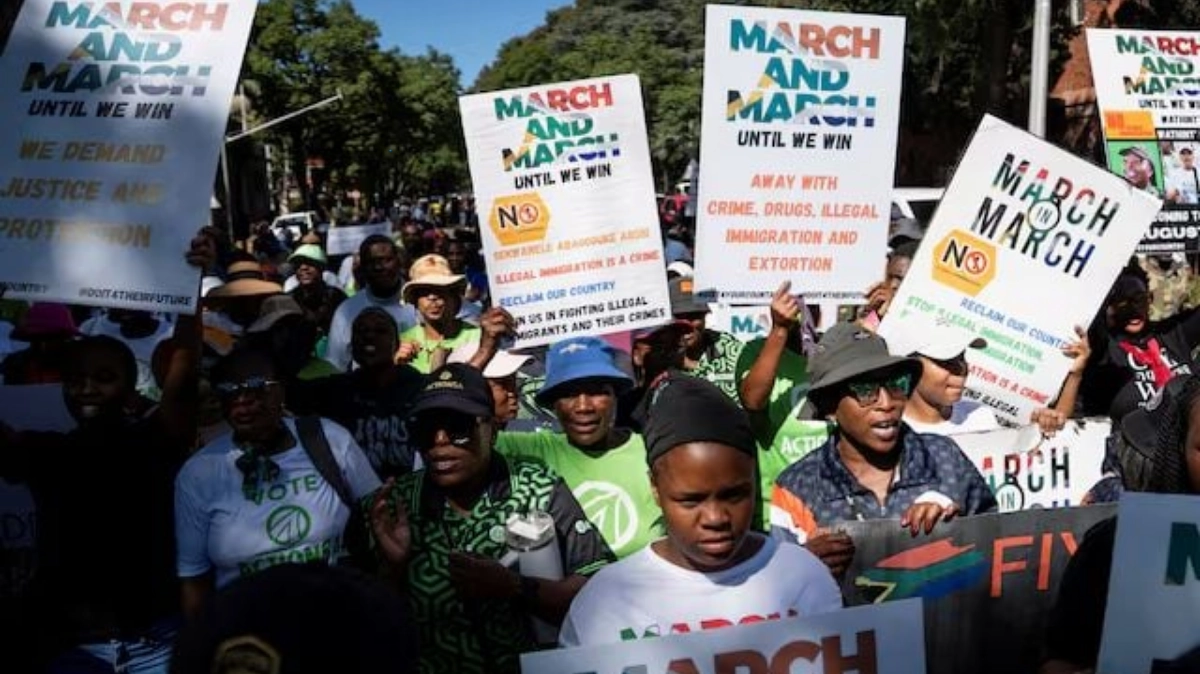
The protests were not abstract. eNCA reports that the nationwide anti-migrant protests drove thousands of foreign nationals out of South Africa.
Southafriworld has documented the scale of the departures, including nearly 100,000 Zimbabweans leaving South Africa, alongside organised repatriations by several African governments.
Read more: https://southafriworld.co.za/nearly-100000-zimbabweans-leave-south-africa/
For residents of the affected areas, the practical consequence of Tuesday’s answer is that the state has not concluded who organised what. No arrests connected to an orchestration finding have been announced, and no agency has been publicly named as leading that work.
It also means no organisation has been accused. Ramaphosa did not refer to any named South African group, and this article should not be read as connecting his remarks to any particular movement.
Southafriworld reported in May on the March and March national shutdown confirmed for 30 June, one of several mobilisations during this period.
Read more: https://southafriworld.co.za/march-and-march-confirms-30-june-national-shutdown/
The migration response timeline, from Cabinet to the ballot box
3 June 2026: Cabinet adopts a Comprehensive Approach for Migration Management.
7 June 2026: Ramaphosa addresses the nation on migration from the Union Buildings.
25 June 2026: Ramaphosa tells the National Council of Provinces that security measures are in place against destabilisation attempts.
30 June 2026: March and March national shutdown.
25 August 2026: Ramaphosa tells the National Assembly that government is deciphering the roles of South Africans and outsiders.
End of August 2026: Madlanga Commission final report due.
4 November 2026: Local government elections.
The line Ramaphosa took on Tuesday is not new. In his 7 June address, he said government would “act against forces who are exploiting the concerns of our people” about illegal immigration for political, personal or criminal ends. He also warned against social media campaigns spreading misinformation about foreign nationals.
Southafriworld covered that address in Ramaphosa’s immigration crackdown.
Read more: https://southafriworld.co.za/ramaphosa-immigration-crackdown/
He repeated the framing to the National Council of Provinces on 25 June, saying government had put security and other measures in place to deal with attempts to destabilise the country, whether by citizens or foreign nationals.
What has changed between June and August is the emphasis on external actors and the statement that an assessment of roles is under way. What has not changed is that no evidence has been produced publicly at any of the three occasions.
The state has previously acted on related material. Southafriworld reported when Cabinet condemned fake xenophobia videos circulating on social media.
Read more: https://southafriworld.co.za/cabinet-condemns-fake-xenophobia-videos/
Water, municipalities and a bruising exchange with the DA
Migration was one of several subjects put to the president. The session also covered the National Water Crisis Action Plan, illegal mining, municipal performance and South Africa’s position on the return to constitutional order in Madagascar.
Ramaphosa foreshadowed far-reaching reforms for municipalities, saying the review of the local government white paper is close to completion.
He was pressed hardest on that point. DA parliamentary leader George Michalakis asked him: “Why did you allow your party, the ANC, to govern municipalities in such a way?” after listing water delivery failures, including 65% water losses in eThekwini and sewage spills.
The exchange lands 70 days before the 4 November local government elections, and two days after Ramaphosa launched the ANC’s local government manifesto in Diepsloot.
What has not been established
Several things remain unconfirmed and are worth stating plainly rather than inferring.
Ramaphosa named no foreign state, organisation or individual. He gave no timeframe for the assessment, did not say which agency is conducting it, and did not indicate whether findings will be published or referred for prosecution.
Southafriworld has also not been able to establish whether the work he described is a formal intelligence or police investigation, or a broader government assessment. The wording used in the National Assembly does not settle that question.
Two dated items sit ahead. The Madlanga Commission into criminality, political interference and corruption in the criminal justice system is expected to submit its final report at the end of August 2026, and voters go to the polls in 257 municipalities on 4 November 2026.