








What the South Africa refinery closures actually cost
Every explanation of a fuel price increase in South Africa names the same two factors: the oil price and the rand. The South African Reserve Bank has now put a figure on a third that nobody mentions.
In an Economic Note published this month, titled Running on empty? South Africa’s refinery closures and their macroeconomic impact, SARB economists estimated that the country’s oil-import bill could have been R76 billion lower between 2021 and 2024 if refined petroleum products had accounted for no more than 25% of total oil imports.
Divided across those four years, that is roughly R19 billion a year. The annualised figure is Southafriworld’s arithmetic, not the Reserve Bank’s.
| Finding | Figure |
|---|---|
| Potential reduction in the oil-import bill, 2021 to 2024 | R76 billion |
| Average annual equivalent | About R19 billion |
| Average reduction in the oil-import bill | 6.1% |
| Price premium of refined products over crude, 2014 to 2024 | 12% |
| Fall in petroleum-related manufacturing output since 2019 | About 20% |
| Direct and indirect jobs displaced | About 5 400 |
| Share of fuel supply met by imported refined products | About 60% |
The Economic Note was not retrieved directly for this article and its findings are reported as attributed rather than independently verified.
Two of five refineries are still running
South Africa had five dedicated crude refineries. Two are operating.
| Refinery | Owner | Capacity | Status |
|---|---|---|---|
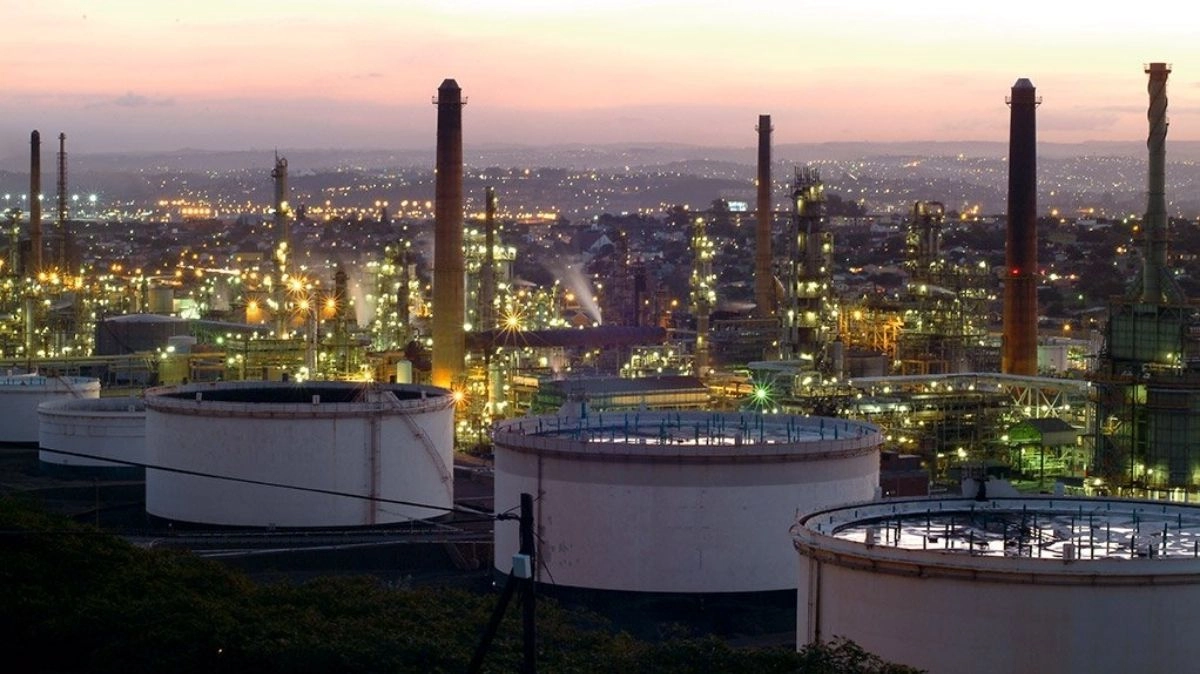
| Sapref, Durban | Shell and BP, since sold to the Central Energy Fund | About 180 000 barrels a day at peak, roughly 35% of national capacity | Paused indefinitely in March 2022 after the Durban floods, never reopened |
| Enref, Durban | Engen | About 120 000 barrels a day, roughly 17% of fuel supply | Shut after a fire in December 2020, converted into a storage terminal |
| PetroSA, Mossel Bay | State-owned | Synthetic fuels | Closed, with Gazprombank Africa named as preferred investment partner for a restart |
| Astron Energy, Cape Town | Glencore | About 100 000 barrels a day | Operating |
| Natref, Sasolburg | Sasol and TotalEnergies | Not stated | Operating |
Sapref was commissioned in 1964 and was the country’s largest refinery. It was later sold to the Central Energy Fund for R1.
Answering questions in the National Assembly on 25 March, Minister of Mineral and Petroleum Resources Gwede Mantashe put the position plainly: about 60% of South Africa’s fuel supply is met through imported refined products, with about 40% processed through domestic refineries and Sasol.
Why they closed, and why nobody is rebuilding
The closures were not simply accidents and floods, though both featured.
The Cleaner Fuels 2 programme tightens fuel specifications, and meeting 10 parts per million diesel requires reconfiguration that the refiners regarded as uneconomic. Trade reporting from the period records that Enref and Sapref had already upgraded to produce 50 parts per million diesel but would have needed further investment to reach 10 parts per million, and chose to close instead.
Carbon tax is cited alongside that. So is the basic economics: refineries are capital-intensive, and a plant with a limited remaining life does not justify the spend.
Nobody is building. There are no plans for new refineries, and the position has effectively been that private investors would build them, while investors see no incentive to do so.
The consequences the Reserve Bank measured are not only at the pump. Petroleum-related manufacturing output has fallen by roughly 20% since 2019, an estimated 5 400 direct and indirect jobs have been displaced, and firms have deferred investment. That sits inside a labour market already under strain.
The part of the fuel price no adjustment can fix
This is where the structural argument meets a household.
The research found that refined petroleum products were on average 12% more expensive than crude oil between 2014 and 2024. South Africa now buys about 60% of its fuel in that more expensive form.
A monthly price adjustment cannot touch that. Neither can a tax cut, a slate levy adjustment, or a stronger rand. Those move the basic fuel price and the exchange rate component. The premium for buying the finished product rather than the raw material sits underneath all of it, every month, regardless of where oil trades.
Speaking to The Star, North-West University Business School economist Professor Raymond Parsons said the estimate was a reminder of the country’s vulnerability, and that “reducing the country’s dependence on imported fuel remains a high priority”. He argued that geopolitical conditions strengthen the case for strategic fuel-reserve policy.
Independent economist Ulrich Joubert took a more measured view of the headline figure, noting that R76 billion is relatively small against the size of the economy. His concern was the transmission. Higher transport costs work through the economy and end up in the price of goods on a shelf, which is the route by which fuel becomes a food price increase and then an inflation problem.
Joubert also cautioned that rebuilding is not straightforward, because refineries are capital-intensive and the cost of rebuilding has to be weighed against the benefit.
What government says it will do
Mantashe has said government intends to rebuild Sapref and PetroSA and increase domestic refining capacity over time. At the department’s 2026/27 Budget Vote in May he said it was “neither sustainable nor just” for a country with South Africa’s mineral and petroleum potential to remain exposed to external supply shocks in this way.
Deputy Minister Phumzile Mgcina told the same debate that the Central Energy Fund is advancing the South African National Petroleum Company’s refinery strategy.
Parsons said the effectiveness of those plans depends on implementation, and questioned whether government can move quickly enough as international energy conditions change.
No timeline has been published for rebuilding either plant. No refinery strategy document has been released. The Department of Mineral and Petroleum Resources had not responded to a request for comment at the time the underlying reporting was published.
Petrol and diesel prices change again on 7 October, and the adjustment will be explained, correctly, by the oil price and the rand. The R76 billion the Reserve Bank has now quantified will not appear in that explanation, and it will not appear in the next one either.
HOW WE REPORTED THIS CROSS-CHECKED
- This article was built from the South African Reserve Bank Economic Note on refinery closures published in September 2026, as reported this week, together with the Minister of Mineral and Petroleum Resources' answer in the National Assembly on 25 March and his department's 2026/27 Budget Vote remarks in May.
- The refinery record was assembled separately from trade reporting covering the period from 2020 to 2024, so that the closures, their capacities and the reasons given for them could be set out individually rather than described in aggregate.
- The annual average of about R19 billion is a Southafriworld calculation dividing the Reserve Bank's four-year figure across the period, and it is labelled as arithmetic in the article rather than presented as a central bank figure.
- The research finding that refined products cost on average 12% more than crude was set against the proportion of supply now imported as finished product, because that relationship is what connects a structural argument to a pump price, and no located coverage had made that connection.
- The Economic Note itself was not retrieved and its findings are reported as attributed rather than as verified, which is stated in the article, and no comment was sought from the Reserve Bank or the department.
- This article was drafted with AI assistance and the facts, figures and quotations were checked against the primary source by the editor before publication.