









ARTICLE BODY
What the new ECMX study actually measured
South Africa’s illicit economy is worth about R280 billion a year across 12 sectors, according to a study by economic consultancy ECMX commissioned by the Consumer Goods Council of South Africa and released in the first week of September 2026. The consequence for anyone who pays tax is direct: the study puts the revenue the state fails to collect because of that trade at a minimum of R68 billion a year.
That R68 billion figure has been the one carried in headlines. It is not the cost of the illicit economy. It is the tax slice of it.
The study separates four different measures of damage. Alongside the lost revenue, it estimates that South Africa’s gross domestic product is R126 billion smaller within the regulated economy, that compliant businesses forfeit R193 billion in formal production, and that more than 87,000 direct formal jobs are displaced.
The distinction matters now because the smaller number has been repeated as though it were the total. The Consumer Goods Council’s own messaging from its August Crime Risk Seminar described organised crime and illicit trade as costing South Africa an estimated R68 billion annually across 11 key sectors, and that framing was still circulating in business coverage on Monday. The new 12-sector study assigns R68 billion specifically to forgone tax revenue and reports a far larger figure for the market itself.
The report covers alcohol, tobacco, clothing, textiles, footwear and leather, food, automotive fuel, gambling, mining, non-alcoholic beverages, pharmaceutical products, cosmetics and personal care, chemicals, and toys and games. ECMX describes it as the first holistic assessment of the economic, fiscal and employment impact of illicit trade across those priority sectors.
What R68 billion in uncollected tax means for people who do pay
Tax that is not collected from the illicit economy does not disappear from the budget. It is made up elsewhere, through what compliant taxpayers pay and through what the state borrows.
A separate study by Frans Cronje Private Clients, titled Shadow State Rising, put the point plainly, finding that the illicit economy “shrinks the tax base, raises borrowing and taxes on the compliant”. That study estimated the economic impact at R84.6 billion, which it described as roughly 1% of GDP and 3.9% of total government revenue.
ECMX links the shortfall to specific spending pressure, saying the lost revenue holds back government’s ability to fund infrastructure, healthcare, education, policing, housing, social protection and industrial development while increasing borrowing and debt-service costs. Southafriworld has previously reported on the growing pressure on South African taxpayers.
The employment side lands hardest on the people with the least room to absorb it. Ilse Fieldgate, head of economic consulting at ECMX, said displacement into illicit or informal supply chains strips workers of minimum wage protection, collective bargaining, occupational health and safety standards, unemployment insurance and pension benefits. She said the displacement falls disproportionately on low- and semi-skilled workers.
Those 87,000 jobs are not retrenchments. They are formal positions that would have existed had the economic activity stayed inside compliant businesses, which is a different and less visible loss than the ones that show up in South Africa’s quarterly unemployment figures.
The five numbers behind South Africa’s illicit economy
| Measure | ECMX estimate | What it counts |
|---|---|---|
| Value of illicit trade across 12 sectors | About R280 billion a year | The size of the illegal market itself |
| Tax revenue lost | At least R68 billion a year | Revenue the state does not collect |
| GDP inside the regulated economy | R126 billion smaller | Formal output that does not happen |
| Formal production forfeited by compliant firms | R193 billion | Sales that shift away from legal businesses |
| Direct formal jobs displaced | More than 87,000 | Jobs that would otherwise have been created |
ECMX is explicit that these are estimates rather than counts. Illicit markets sit outside official statistics, so the report uses a triangulation approach combining Statistics South Africa supply and use tables, national accounts and non-observed economy estimates with customs and mirror-trade analysis, SARS seizure data, industry and regulatory information, and sector-specific research.
Where no comparable sector research exists, the report developed its own illicit-penetration estimates, which it describes as evidence-informed modelling assumptions rather than directly observed measures, using lower-bound, central and sensitivity ranges. The R280 billion figure is presented as a conservative estimate.
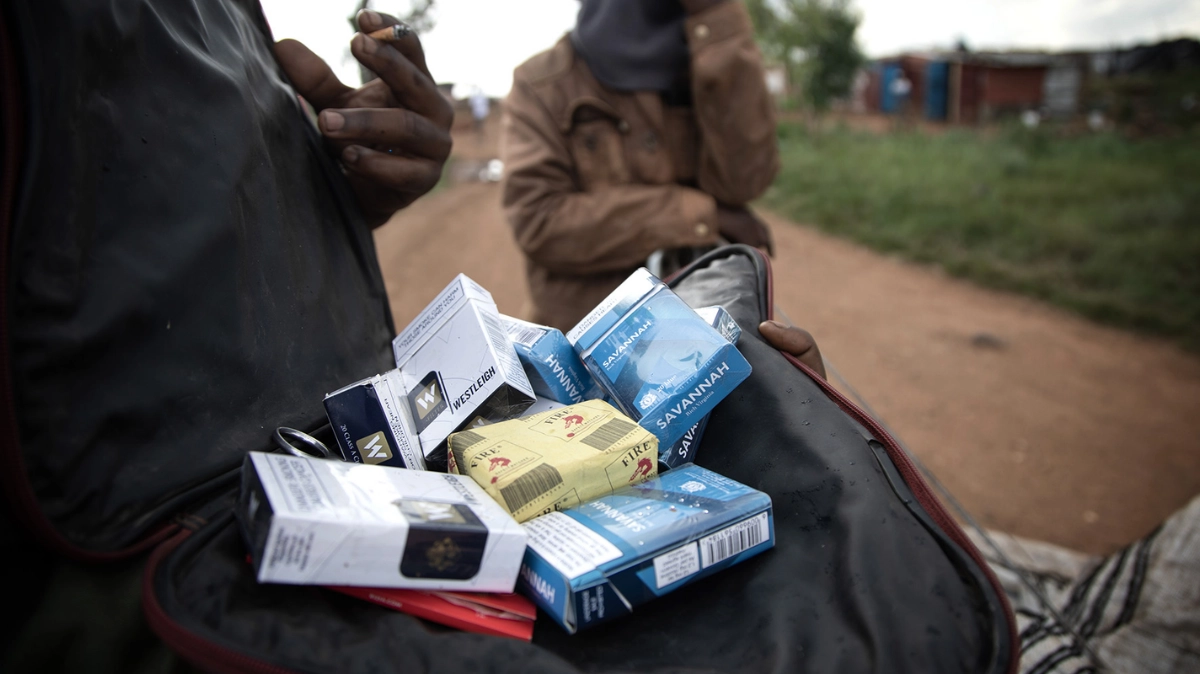
Tobacco is the sector with the longest research trail. Southafriworld reported earlier this year on research placing illicit cigarettes at 60% of the market. ECMX cites the closure of British American Tobacco’s Heidelberg factory as an example of manufacturing capacity lost to the illegal trade.
Fieldgate said illicit trade in several sectors is tied to organised criminal networks running customs fraud, smuggling, counterfeiting, money laundering and corruption, and that it therefore represents “not only an economic challenge but also a governance and national security concern”.
Operation Ukubusa has been running since April with no published score
The government’s response already exists and already has a name. President Cyril Ramaphosa announced a National Illicit Economy Disruption Programme in his February 2026 State of the Nation Address, and it was launched as Operation Ukubusa on 1 April 2026.
In a written reply to a parliamentary question from ActionSA Member of Parliament Alan Beesley in March, Ramaphosa said coordination runs through the Justice, Crime Prevention and Security cluster, with the visible policing division of the South African Police Service leading through its section head for emerging economic crime. Participating bodies include the SAPS, the Directorate for Priority Crime Investigation, SARS, the National Prosecuting Authority and the Department of Home Affairs.
That reply also set out how success would be measured: disruption of organised criminal networks, seizures of illicit goods, arrests and successful prosecutions, and recovery of revenue and assets.
More than five months after launch, no consolidated public tally against those four indicators has been published. Progress is reported through the cluster to Cabinet rather than in a public scorecard.
Consumer Goods Council of South Africa chief executive Zinhle Tyikwe called Operation Ukubusa a welcome step, but set the same test. The turning point comes, she said, “when we see arrests and successful prosecutions of the kingpins”.
The council has asked consumers to check product authenticity through its MyCGCSA app and report suspect goods to its crime hotline on 0800 014 856. Whether Operation Ukubusa is working will only be answerable when the arrest and prosecution numbers are made public.