








What we know so far
Morocco has displaced South Africa as the most industrialised economy on the African continent, ending a 15-year run at the top that South Africa had held since the African Development Bank’s (AfDB) index began tracking performance in 2010.
The AfDB’s Africa Industrialisation Index (AII) 2025, released on the sidelines of the bank’s 2026 Annual Meetings in Brazzaville, Republic of Congo, placed Morocco at a score of 0.8415, narrowly ahead of South Africa’s 0.8396. The margin is slim, but the direction of travel is not.
The index, which assessed industrial development across all 54 African countries between 2010 and 2024, credited Morocco’s rise to sustained industrial policy, export diversification, and manufacturing growth concentrated in its automotive, aerospace, and phosphate sectors. For South Africa, the AfDB’s verdict was pointed: the country “continues to experience a steady decline in industrial competitiveness.”
Why it matters
South Africa’s displacement is not merely a symbolic loss of a ranking. It reflects a structural deterioration in the country’s manufacturing capacity, investment attractiveness, and logistics infrastructure that has compounded over more than a decade.
The country’s gross domestic product grew at an average of less than 1% annually over the past ten years, according to the AfDB report. That chronic underperformance has its roots in two failures that the index directly identifies: the collapse of Eskom’s electricity supply reliability, which forced manufacturers into costly self-generation, and the breakdown of Transnet’s rail and port network, which pushed freight onto roads and created sustained bottlenecks at Durban and Cape Town.
The consequences run deeper than inconvenience. Gross fixed capital formation, the measure of new investment in productive assets, contracted by 3.7% across 2024, its worst performance since the COVID-19 pandemic, according to data from Statistics South Africa. State-owned enterprises alone allocated only R110 billion to fixed capital formation in 2024, compared with a peak of R230 billion in 2013.
For manufacturers, investors, and exporters, South Africa’s industrial decline means higher operating costs, reduced competitiveness in global markets, and a weakening ability to generate the kind of productive employment that structural economic transformation requires.
Key details and figures
The scores that separated the two countries were narrow but decisive. Morocco registered 0.8415 on the AfDB index against South Africa’s 0.8396. Behind them, Egypt ranked third, followed by Tunisia, Mauritius, Algeria, Eswatini, Senegal, Namibia, and Cote d’Ivoire to complete the top ten.
Morocco’s ascent was built on deliberate, long-term policy choices. The AfDB attributed the country’s rise to sustained industrial upgrading and the consistent implementation of strategic industrial policies over two decades. In the automotive sector, Morocco has developed into a major production and export platform for European manufacturers. In aerospace, French aerospace firm Safran announced a 200 million euro investment in October 2025 to establish an engine assembly line for Airbus near Casablanca, alongside a maintenance unit, deepening the country’s integration into high-value global supply chains.
Physical infrastructure has reinforced this trajectory. The Tanger Med port, the Al Boraq high-speed rail line connecting Casablanca to Tangier, and the Nador West Med industrial complex have together positioned Morocco as a manufacturing and logistics hub connecting Europe, Africa, and the Middle East. North Africa, as a region, attracted 56% of cumulative continental industrial investment between 2020 and 2025, according to the AfDB’s companion report, the inaugural Africa Industrial Investment Barometer.
South Africa’s trajectory contrasts sharply. Transnet’s freight rail volumes fell from 226 million tonnes in 2017 to approximately 150 million tonnes in 2024, a collapse that pushed mining and agricultural exporters onto road transport and drove up logistics costs. Eskom’s electricity output fell by an average of 2.7% annually between 2011 and 2024, according to economic research institution TIPS, forcing businesses to invest in costly private generation capacity rather than expanding productive operations.
The AfDB index examined industrialisation not only through the lens of manufacturing volume, but also productive sophistication, export diversification, and integration into global value chains. On all these measures, Morocco advanced while South Africa stagnated.
Across the broader continent, 41 of Africa’s 54 countries improved their industrialisation scores between 2010 and 2024, with the continental average rising 6%. Yet Africa still accounts for less than 2% of global manufacturing output and only 1.4% of global manufacturing exports, according to the AfDB report, underscoring how much ground the continent as a whole still needs to cover.
Intra-African trade remains a structural weakness at just 14.4% of total trade, reflecting fragmented regional production linkages that limit the scale advantages manufacturers need to become globally competitive.
What happens next
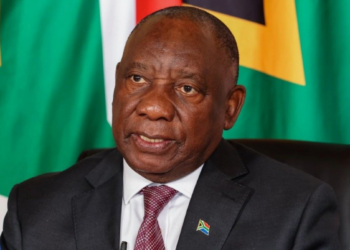
South Africa’s government has acknowledged the scale of what is required to reverse the trend. President Cyril Ramaphosa has publicly estimated that the country needs R1.6 trillion in public-sector infrastructure investment and a further R3.2 trillion from the private sector to meet its infrastructure goals by 2030. Finance Minister Enoch Godongwana’s 2025 Budget speech allocated approximately R1 trillion over three years toward infrastructure, but analysts and research institutions have noted that this falls well short of what is needed.
The AfDB’s companion barometer identified the core challenge clearly. Dr Harouna Kaboré, president of WITBA Invest SA, said what Africa’s industrial economies lack is not the absence of industrial strategies, but “execution discipline, continuity in public policy, and systemic coherence between financing, energy, infrastructure, human capital, governance, and industrial vision.”
For South Africa, that diagnosis maps directly onto the Eskom and Transnet crises. Eskom made measurable progress in reducing load-shedding through 2024 and into 2025, but electricity supply remains constrained by years of underinvestment in maintenance and new generating capacity. Transnet’s rail recovery remains incomplete, with port efficiency at Durban and Cape Town still drawing consistently poor ratings in international logistics benchmarks.
The AfDB index will be updated as data for 2025 becomes available. Whether South Africa begins to close the gap with Morocco will depend substantially on whether the infrastructure reforms underway translate into tangible improvements in manufacturing input costs, logistics reliability, and investor confidence. For now, the evidence points in one direction: a gap that has been widening for more than a decade, and one that will not close quickly.