








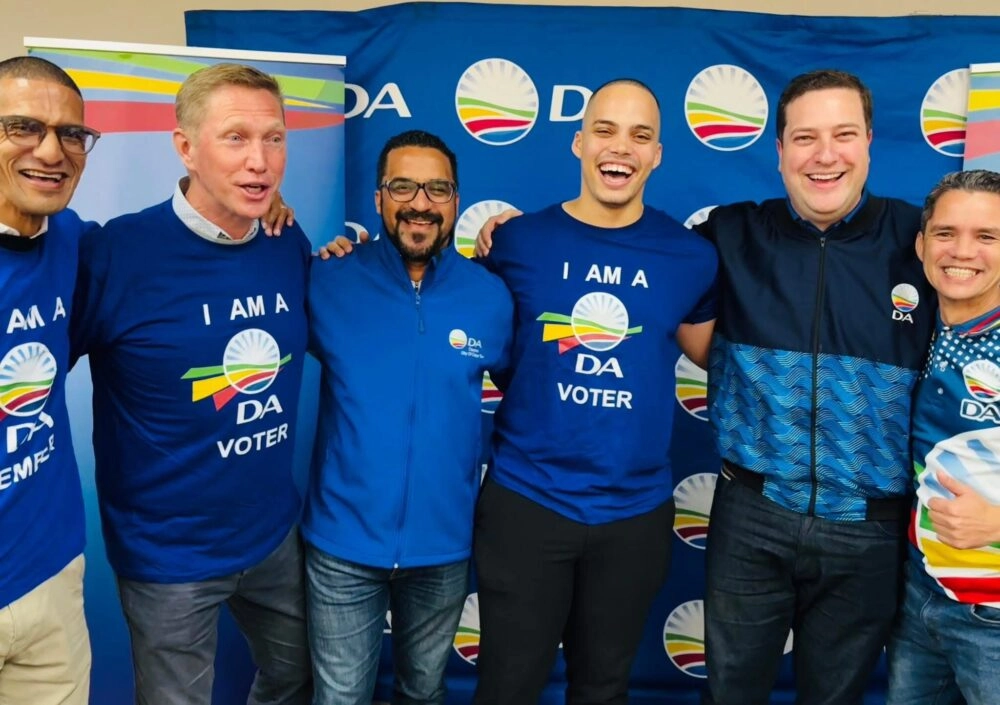
What we know so far
Liam Jacobs has returned to the Democratic Alliance after a short stint with the Patriotic Alliance. Jacobs, 25, surprised many in the DA when McKenzie announced on Facebook that Jacobs had joined the PA. When Jacobs left, he said he felt he was “being used” by the DA.
In a statement released on Tuesday, the Northern Cape-born politician acknowledged that many South Africans would question his decision to rejoin the DA after his high-profile departure in 2025. “Well, the fact is: I should never have left the DA in the first place,” Jacobs said. He added: “I believed Gayton [McKenzie]. I believed the PA promises. I personally saw that I was misled by lies. I admit, I made a mistake.”
The DA’s Federal Leader, Geordin Hill-Lewis, announced Jacobs’ return on social media on Monday. According to two sources, Jacobs returned after Hill-Lewis made the case for his comeback as a consultant during an online meeting on Sunday evening. Hill-Lewis is said to have made the presentation on Sunday, with the decision being ratified by the federal executive on Monday morning.
Why it matters
The DA is said to be banking on Jacobs to lure the coloured vote and to curb the rising losses in by-elections in the Western Cape, where the PA has seen a meteoric rise. His return is therefore not simply a personal matter; it is a calculated opposition party play in a fiercely contested electoral cycle.
The return of Jacobs comes as political parties begin intensifying their campaigns ahead of the November election, which is expected to be fiercely contested. The DA has positioned itself as a national alternative focused on governance and economic growth, while seeking to attract supporters from across the political spectrum.
PA leader Gayton McKenzie challenged Jacobs, stating that the DA does not allow coloured politicians to rise to top leadership positions despite their qualifications. That counter-claim has sharpened the public spat between the two parties and opened a wider debate about the political representation of coloured South Africans ahead of the November local government elections.
Key details and figures
Jacobs holds an Honours degree in Philosophy, Politics and Economics from the University of Pretoria. He rose to prominence as leader of the Democratic Alliance Students Organisation (DASO) from 2022 and was elected to the National Assembly representing Gauteng in the 2024 general election.
Jacobs left the DA in June 2025 to join the PA while he was serving as a member of parliament. Jacobs was touted to be the PA’s mayoral candidate in Cape Town. On 17 April 2026, he announced that he would be returning to Parliament under the banner of the PA. His defection back to the DA came less than two months after that announcement.
Jacobs also apologised to DA supporters, leaders, public representatives, activists and staff for the manner in which he left the party. In his public statement, he went further than a simple apology, levelling a series of specific allegations against the PA.
Jacobs said the PA “sold out its voters to the ANC”, adding that the party functioned as “a cheerleader”. He also said the PA promotes xenophobia and that “decisions in the PA are made by one man”. He also said that party members were instructed to defend National Coloured Congress leader Fadiel Adams, who is facing charges of fraud and obstructing the administration of justice.
Jacobs stated: “Coloureds are not criminals. Criminal culture is not coloured culture. However, in the PA, we were instructed to defend Mr Fadiel Adams, saying that he was arrested because he was coloured. This is false; the allegations against Adams are his own, and he must answer for his actions.”
Jacobs described the DA as the best vehicle for those seeking an alternative to ANC rule. “I can’t wait to see more and more people come to the DA so we can be the biggest party in the country. The DA is a party that is serious about defeating the ANC, so if you don’t want an ANC government and if you don’t want to be governed by the friends of the ANC, then you know where your home is,” he said.
Hill-Lewis welcomed his return publicly and with notable warmth. “Welcome home. It’s amazing to have you back in the DA,” Hill-Lewis wrote. “It would be a mistake not to expect anyone to make mistakes. You have to learn and grow. When you left, Helen said something very profound, that you are a young man who is very talented, and as often, she was right. This is not about me, Liam, or Tertius. It’s about making our country succeed.”
In a formal statement, Hill-Lewis framed the return in explicitly electoral terms. “We are not interested in the politics of chaos, personality cults and empty promises. Liam Jacobs left the PA because he saw first-hand that the PA never delivers on promises. People sometimes take the wrong road. What matters is whether they are willing to correct course and recommit themselves to the work of building a better South Africa.”
According to one of two DA insiders, Jacobs was not promised a position. Another source said that although there was pushback on the idea of Jacobs’ return, the DA agreed it “needs” him.
What happens next
McKenzie reacted strongly to the departure. He spoke in a video posted on social media and said that Liam Jacobs was never trusted within the PA following Jacobs’ defection back to the DA on 31 May 2026. McKenzie claimed senior PA leaders had reservations about Jacobs and accused him of failing to connect with grassroots supporters.
McKenzie warned Jacobs against continuing to speak publicly about the party. “We never trusted you in the PA. Nobody trusted you in the PA,” McKenzie said.
The DA insiders said Jacobs felt he was being “muzzled” in the PA. The public exchange between Jacobs and McKenzie is ongoing and is expected to intensify as both parties compete directly for coloured voters in the Western Cape.
Jacobs said international travel had reshaped his perspective: “International travel is important. You discover who you are outside of who you are. You discover your values.”
Whether the DA deploys Jacobs in a formal capacity before November or keeps him as a consultant, as sources described his initial role, remains to be confirmed by the party. No parliamentary seat is currently available to him, as he resigned his National Assembly seat when he joined the PA. His precise role heading into the November local government elections has not been announced.
The DA’s decision to bring Jacobs back reflects its anxiety about slipping support among coloured voters in the Western Cape, a constituency that has been central to the party’s electoral dominance in that province. How voters respond to a politician who has publicly reversed course twice within twelve months will be one of the defining subplots of that campaign.