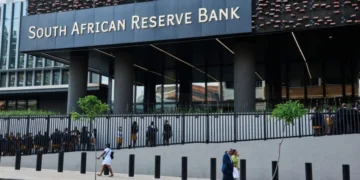






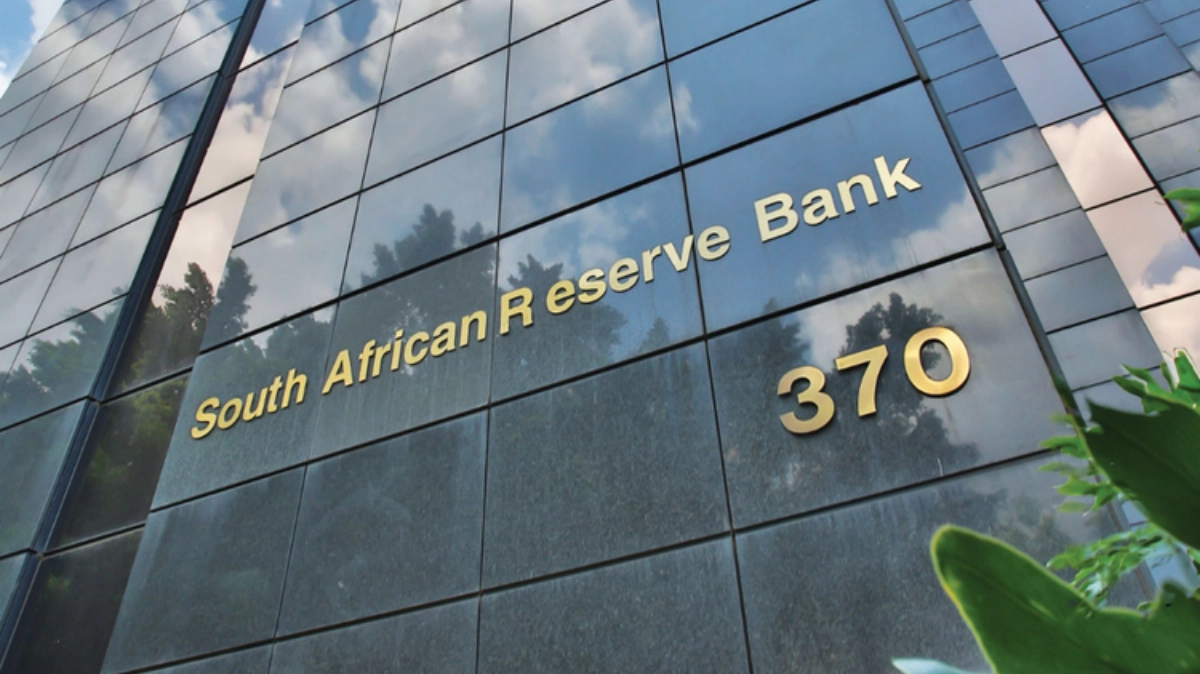
Mark Burke Kastelo is the search South Africans are running after a High Court judgment revealed the scale of a South African Reserve Bank investigation into the fintech firm. The Gauteng Division of the High Court in Johannesburg dismissed Kastelo’s application to set aside a Reserve Bank blocking order on 28 July 2026, and ordered the company to pay costs on the punitive attorney-and-client scale. Kastelo was co-founded and formerly chaired by Mark Burke, the Democratic Alliance’s federal finance chairperson and a member of Parliament. No finding of wrongdoing has been made against Kastelo or against Burke.
The case at a glance
| Item | Detail |
|---|---|
| Case | Kastelo (Pty) Ltd v South African Reserve Bank and Others, 2025-247149 |
| Court | Gauteng Division of the High Court, Johannesburg |
| Judge | Johnson AJ |
| Blocking order issued | 24 November 2025, by FinSurv official Andre Malherbe |
| Amount blocked | About R13 million held with Access Bank |
| Amount under suspicion | At least R4 billion in cross-border transfers |
| Heard | 9 June 2026 |
| Judgment | 28 July 2026, application dismissed with punitive costs |
What the court actually decided
This point matters and most coverage has blurred it. The court was not asked whether Kastelo broke the law. It was asked whether the Reserve Bank official who issued the blocking order had reasonable grounds to suspect that it had.
That is a deliberately low threshold. The judgment sets out that under Regulation 22D read with section 9(2)(d)(i) of the Currency and Exchanges Act, a court may set aside a blocking order only if the official did not follow the regulations, did not have reasonable grounds, or if those grounds no longer exist. Johnson AJ found Malherbe had reasonable grounds and accepted his version. The order reads: “The application is dismissed.”
The judgment also confirms the Reserve Bank has 36 months from the date of the blocking order to complete its investigation. That runs to about November 2028. Only at the end of that process, and only if the Governor is satisfied contraventions occurred, could forfeiture follow, and only then would Kastelo be entitled to be heard.
What the Reserve Bank alleges
The investigation was not triggered by a political opponent. According to the judgment, Kastelo’s own bank, Access Bank, reported suspicious transactions after conducting its own forensic review, having considered ending the relationship but not wanting to pass what it saw as regulation breaches to another bank.
The Financial Surveillance Department alleges Kastelo used clients’ Single Discretionary Allowances of R1 million and Foreign Investment Allowances of R10 million to buy foreign currency and acquire crypto assets offshore, for Kastelo’s own benefit. The judgment records that Kastelo’s website advertised bonuses of R2 000 for an SDA investment and R10 000 for an FIA investment.
FinSurv further alleges Kastelo lent clients the money to use those allowances, which it treats as simulated transactions designed to circumvent exchange controls. Access Bank’s review found clients earning about R15 000 a month receiving loans of about R249 000. The Reserve Bank also alleges Kastelo, as a Treasury Outsourcing Company, acted as a principal rather than an intermediary, which the Authorised Dealer Manual does not permit.
One caution on the headline number. The judgment attaches the R4 billion figure to three different periods in three different paragraphs: a full calendar year to 21 November 2025, a window from 4 August to 21 November 2025, and a four-year span from November 2021. The figure is consistent, the period is not. Anyone citing it should say “at least R4 billion in transactions the Reserve Bank suspects” rather than fixing it to a timeframe.
The Reserve Bank declined to elaborate beyond the court record. “The SARB will not be commenting further,” it said.
What Kastelo says
Kastelo denies the characterisation. It says its clients trade in their own names using their own allowances under a discretionary mandate, that value is repatriated to South Africa in rand at the end of each trading cycle, and that clients using credit undergo affordability assessments under the National Credit Act.
On the ruling itself, the company says the matter was narrow and administrative, and that “the court made no finding against Kastelo’s business activities”. That characterisation is supported by the judgment, which turned on reasonable suspicion rather than proof.
Kastelo says it has voluntarily paused its arbitrage services and continues to operate under its existing licences. It says the Reserve Bank has recorded no findings against it to date.
Where Mark Burke fits, and where he does not
Burke co-founded Kastelo in Cape Town in 2018 and served as chief executive until June 2024, when he entered Parliament after the national elections. His brother Nicholas Burke became CEO. Mark Burke remained chairman until February 2026.
He is not a party to the court proceedings. Kastelo says he stepped down as chairman, retains an indirect interest in the group, holds no executive or non-executive role, and is not a subject of the Reserve Bank’s investigation. The Reserve Bank declined to confirm whether it is investigating either Burke in a personal capacity.
Burke was elected the DA’s federal finance chairperson on 12 April 2026, replacing Dion George. He holds a PhD in econometrics from Cambridge and sits on Parliament’s finance structures.
The political fallout
DA leader Geordin Hill-Lewis has backed him. “Mark Burke is no longer the chairperson of Kastelo,” Hill-Lewis told the Sunday Times, adding that no allegations of wrongdoing had been made against Burke personally and that the party would allow the regulatory process to run.
The ANC parliamentary caucus has called for Burke’s removal from Parliament’s finance committees, arguing the committee cannot credibly oversee the Reserve Bank while one of its members is the subject of a Reserve Bank affidavit. ANC chief whip’s office member Cameron Dugmore said the party would raise it with the Speaker. “The immediate thing is that the DA needs to remove Burke,” he said.
The tension between a strong currency position and a weak fiscal one has been a running theme this year, from the rand’s recovery to the pressures set out in our Budget 2026 analysis.
Questions readers are asking
Is crypto arbitrage illegal in South Africa? No. Using your own annual allowances to trade offshore is lawful. What the Reserve Bank suspects here is the use of other people’s allowances for a company’s own benefit, which is a different question.
How much can I take offshore each year? R1 million under the Single Discretionary Allowance, which only requires reporting, and up to R10 million under the Foreign Investment Allowance, which requires Reserve Bank approval.
Has Mark Burke been charged with anything? No. He is not a party to the case and no criminal or civil proceedings against him personally have been reported.
Has Kastelo been found guilty of anything? No. The court ruled only that the Reserve Bank had reasonable grounds to suspect a contravention.
What is a blocking order? A temporary preservation measure under Regulations 22A and 22C of the Exchange Control Regulations. It freezes funds while an investigation runs.
What to watch
The Reserve Bank investigation has until roughly November 2028 to conclude. Watch for whether Kastelo seeks leave to appeal the 28 July judgment, whether the Speaker acts on the ANC’s request regarding the finance committee, whether Parliament’s Joint Committee on Ethics opens an inquiry, and whether FinSurv moves from a blocking order to forfeiture proceedings, which is the stage at which Kastelo would be entitled to be heard.