









What was signed in Beijing
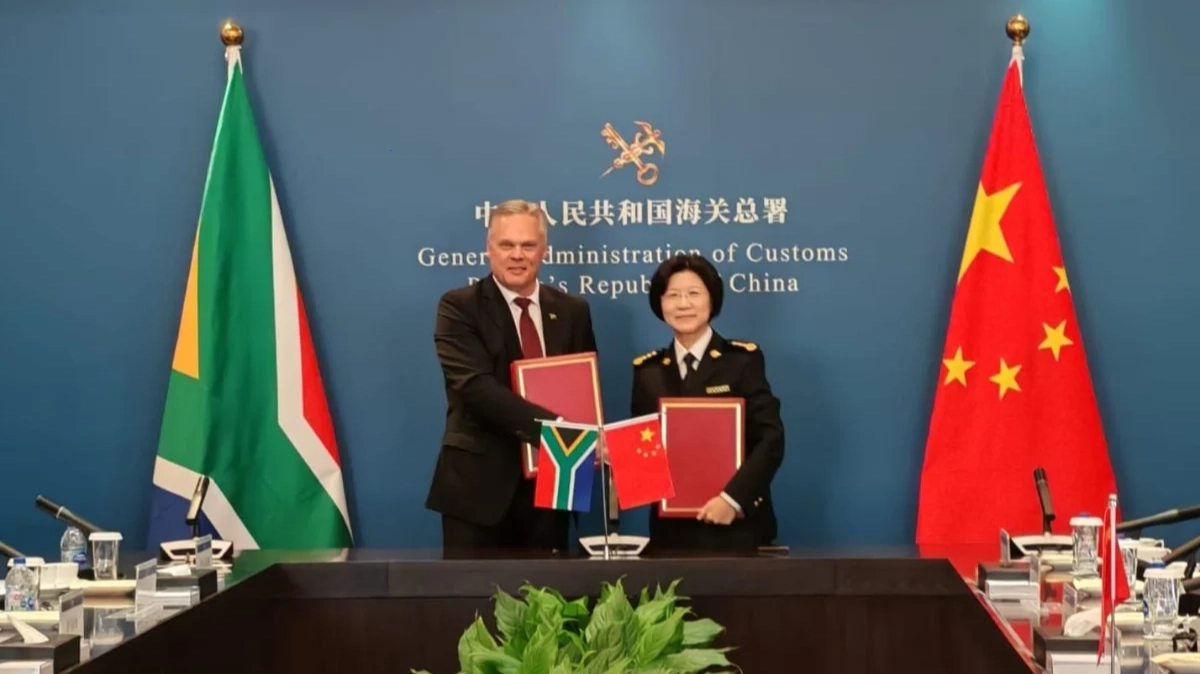
Cherry exports to China will be duty-free for the first time after Minister of Agriculture Willie Aucamp and Sun Meijun, Minister of the General Administration of Customs of China, signed a market access protocol in Beijing on Tuesday, 8 September 2026.
For growers, the consequence is a new destination for a crop that currently has few. For readers, the figure worth holding onto is not the one in the headlines.
The signing took place during the ninth Sanitary and Phytosanitary Ministerial Meeting. South Africa’s ambassador to China, Dipuo Letsatsi-Duba, and China’s ambassador to South Africa, Wu Peng, attended.
Aucamp called the outcome record-breaking, saying it was “the first time that two market access protocols have been signed with China within a year”. He said the protocol confirms commitments made under the Framework Agreement on Economic Partnership for Shared Development and gives South Africa 0% tariff access to the Chinese market.
The Department of Agriculture expects the opening to stimulate investment in production and create around 600 jobs.
What cherry exports to China are actually worth
Every report of this deal carries the same two numbers: China imported about 586,900 tonnes of cherries in 2025, worth US$3.3 billion, which the department converts to R52.8 billion.
That figure describes China’s total import market from all suppliers. It is not a South African export opportunity, and the reason is in a number that has appeared only once in the coverage.
Wandile Sihlobo, chief economist of the Agricultural Business Chamber of South Africa, put South Africa’s cherry harvest at around 3,006 tonnes, and said the country remains a small player.
| Measure | Figure |
|---|---|
| China’s cherry imports, 2025 | About 586,900 tonnes |
| Value of those imports | US$3.3 billion, about R52.8 billion |
| Implied average import value per tonne | About US$5,600, or roughly R90,000 |
| South Africa’s annual cherry harvest | About 3,006 tonnes |
| The whole South African crop as a share of China’s imports | About 0.5% |
| That crop valued at China’s average import price | About R270 million |
| Jobs the department expects the protocol to create | About 600 |
The last four rows are Southafriworld calculations from the published figures. Dividing US$3.3 billion by 586,900 tonnes gives the average unit value, and the department’s own conversion implies an exchange rate of R16.00 to the dollar.
If South Africa shipped every cherry it grows to China and none stayed home, it would supply about half of one percent of what China buys from the world each year. Sihlobo has been clear that this will not happen. “Exports won’t take everything away from the domestic side,” he said, adding that there will be volume for both domestic consumption and export, and that South Africans can still expect affordable cherries in stores.
Actual first-season export volumes will therefore be a fraction of 3,006 tonnes.
Why the deal still matters for a small industry
None of that makes the protocol unimportant. It changes what the industry can plan for.
Market access protocols are slow. South Africa’s lemon access to China took from 2013, when Citrus Research International scientists began the compliance work, to the first shipment in February 2022. Securing access before an industry has scale is how an industry gets scale.
Sihlobo framed it in those terms, saying the export avenue will ensure the South African cherry industry continues to grow over the long term. The 600 jobs the department cites are consistent with expansion rather than with shipping the current crop, though no timeline or basis for that figure has been published.
South African exporters will still have to compete. Fruit size, eating quality, harvest timing and transport will shape whether South African cherries find buyers in a market already supplied at scale by established Southern Hemisphere producers.
Timing is the immediate variable. Sihlobo said this year’s harvest starts next month, which places the first potential season under the summer that the weather service has flagged in its El Niño warning, with below-normal rainfall the most likely outcome over most of the country.
The fourth trade opening in a month
The cherry protocol is the fourth agricultural trade development for South Africa in as many weeks.
The Department of Agriculture concluded negotiations with Egypt on a Veterinary Health Certificate for red meat exports last week, though that certificate has not yet been signed. Before that, a ten-year deadlock with India over citrus was broken when India agreed to include additional treatment options for fresh South African citrus, opening a market of nearly 1.5 billion people.
The United States also extended the African Growth and Opportunity Act to December 2028. That extension is less clear-cut. Questions remain over whether South Africa will still qualify when the next phase begins in January 2027, and the period is short for an industry that needs long horizons to justify planting. Southafriworld has previously reported on the strain in the South Africa and United States trade relationship.
Read together, the four developments describe a deliberate widening of destinations at a point when the largest single market carries the most political risk.
What comes next
Blueberries are next in the queue. Aucamp said “there is more to come between South Africa and China” now that blueberry negotiations are at an advanced stage, and China has submitted a draft import protocol for South Africa’s consideration. He has asked officials to fast-track inputs with the aim of finalising it before the end of 2026.
Biosecurity is the other live track. Aucamp met China’s Minister of Agriculture and Rural Affairs, Zhang Zhu, on Monday, 7 September, where the two reaffirmed cooperation on biosecurity and specifically on foot and mouth disease, the outbreak that has closed several markets to South African red meat.
Several things are unresolved. No orchard or packhouse registration list has been published, and Chinese market access typically requires the customs administration to approve specific registered facilities before any consignment can move. No first shipment date has been announced. And the 600-job estimate has been given without a timeframe or a stated methodology.
The cherry harvest begins next month, and the blueberry protocol is the next document to watch before the end of the year.