






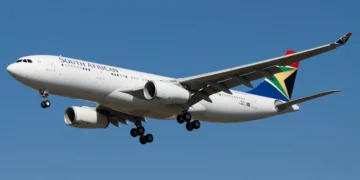



Flights between South Africa and major Middle East hubs were disrupted on Saturday, 28 February 2026 after a rapid escalation between the United States, Israel and Iran triggered airspace closures across parts of the region. Airlines began cancelling, diverting and pausing services as aviation authorities and carriers prioritised safety.
For South African travellers, the most immediate impact is on connections through Dubai and Doha. Emirates has confirmed a temporary suspension of operations to and from Dubai due to “multiple regional airspace closures”, while Qatar Airways has confirmed a temporary suspension of flights to and from Doha due to the closure of Qatari airspace.
What happened and why airspace is closing
The latest disruptions followed joint US and Israeli strikes on Iran and Iran’s response, which quickly expanded into a wider aviation risk across the Gulf and surrounding air corridors. Reuters reported that airspace over Iran, Iraq, Kuwait, Israel and Bahrain was largely vacated, and airlines across the world began suspending flights or rerouting aircraft away from the conflict zone.
In such situations, countries can temporarily close national airspace via notices to air missions and related aviation directives when there is an elevated risk to civilian aircraft. Closures can also be partial, such as restrictions at certain altitudes, or time-limited shutdowns that can still cause extensive knock-on delays because aircraft and crews are already positioned across the network.
The immediate risk for airlines is not only overflight safety. A sudden closure around key hubs can make it impossible to land, depart, refuel or re-route without significant delays. The Associated Press reported that airspace closures around the Gulf affected major hubs and triggered flight cancellations and diversions by multiple airlines.
What it means for South Africa travellers
South Africa’s long-haul travel relies heavily on Middle East hubs for onward connections to Europe, North America and Asia. When hubs such as Dubai and Doha pause operations, the disruption cascades quickly:
- Passengers can be stranded at departure airports in South Africa if outbound services are delayed or cancelled.
- Connecting passengers can be stuck in transit if inbound flights land but onward departures are suspended.
- Aircraft may divert to alternate airports, which changes crew duty times and creates further cancellations on later rotations.
South African travel advisers and media reporting on Saturday indicated that Emirates and Qatar Airways departures from South Africa were affected, with customers urged to check booking status before heading to airports.
The situation can be particularly complex for travellers on through-tickets, because an initial delay in Johannesburg or Cape Town can cause missed long-haul connections that are normally time-sensitive.
What Emirates and Qatar Airways have officially said
Emirates
Emirates published a travel update stating that, due to multiple regional airspace closures, it has temporarily suspended all operations to and from Dubai. The airline advised customers to check flight status before proceeding to the airport and indicated that rebooking support is available through travel agents or Emirates channels, depending on how the ticket was purchased.
Qatar Airways
Qatar Airways issued a press release confirming the temporary suspension of flights to and from Doha due to the closure of Qatari airspace. The airline said it is working with government stakeholders and authorities to support impacted passengers and will resume operations when airspace reopens, warning that delays are likely once operations restart.
Why reroutes and cancellations can last longer than the airspace closure
Even if airspace restrictions are short, airlines can take days to fully recover schedules. A disruption that grounds aircraft for a few hours can create a backlog in several ways:
- Aircraft are out of position
A long-haul aircraft that cannot reach Dubai or Doha may divert elsewhere, which affects its next planned sector. - Crew duty limits are exceeded
Crew members have strict duty time limits. A diversion can push crews beyond allowable hours, requiring rest and replacement. - Airport capacity becomes constrained
When operations resume, large hubs must handle delayed arrivals, missed connections and rebooked passengers, often with limited gate space. - Wider network ripple effects
Flights out of South Africa may depend on aircraft arriving from elsewhere. If that inbound aircraft is late, the South Africa departure is delayed.
Reuters also noted that airlines were rerouting around the affected region and that European aviation authorities advised avoiding conflict-affected airspace, reflecting the seriousness of the risk environment.
What South Africans should do if they are travelling now
Travellers scheduled to fly on routes that connect through the Middle East should treat Saturday’s disruptions as a live, developing safety and logistics issue. The most practical steps are:
- Check flight status directly with the airline before leaving for the airport. Emirates and Qatar Airways have published live travel updates and alerts.
- Do not rely on standard departure times if the aircraft is coming from a disrupted hub. A flight can show as “on time” and then change quickly.
- If booked through a travel agency, contact the agent first for rebooking, especially if the ticket includes multiple airlines.
- Confirm connection rules for transit visas and overnight stays if a hub diverts passengers to alternate airports.
- Keep essential medication in hand luggage, and plan for long waits at airports.
- Check travel insurance conditions on trip interruption and war-related exclusions, and keep receipts for accommodation and meals.
What South African businesses should watch
Beyond leisure travel, these disruptions matter for corporate travel, freight and time-sensitive supply chains.
- Cargo capacity can tighten when passenger widebody flights are cancelled, because belly-hold cargo moves on passenger aircraft.
- Business travel costs can rise as seats become scarce on alternative routings, especially if travellers must detour via Europe or Africa.
- Meeting schedules can be affected because Middle East hubs are key connectors for global conferences and trade activity linked to South Africa’s business cycle.
Local aviation and tourism bodies typically advise companies to prioritise traveller welfare and ensure staff have clear emergency contact channels during disruption periods.
What happens next
The immediate outlook depends on three factors:
- Whether airspace restrictions expand or narrow across the Gulf and surrounding corridors.
- Whether major hubs resume normal operations, including capacity to handle backlogs.
- How quickly airlines reposition aircraft and crews to restore schedules.
Even if restrictions ease quickly, the backlog of rebookings and diversions can keep disruption elevated into the start of the new week. South Africans travelling internationally, especially via Dubai and Doha, should expect delays and last-minute changes until normal operations stabilise.