





The Sharpeville massacre lawsuit filed at the High Court on Thursday is not the first attempt to make the state pay. It is the second.
The first was made in 1960. About 258 claims were served on the Minister of Justice that September, seeking £400 000, then equivalent to R800 000.
In July 1961 Parliament passed the Indemnity Act, and every one of those claims fell away.
A committee was later set up to recommend discretionary payments. Roughly a third of the claimants received something. The total came to less than 4% of what had been sought.
That Act is still on the statute book, 65 years later, and it is what Lawyers for Human Rights and the United Kingdom firm Leigh Day are now asking a court to strike down.
What the Indemnity Act actually covers
The Act indemnified the government, and anyone acting under its authority, for acts carried out in good faith for the prevention or suppression of internal disorder, the maintenance or restoration of good order, public safety or essential services, or the preservation of life or property.
It applies to the period from 21 March 1960 to 5 July 1961. That is more than 15 months, not a single afternoon.
It remains in force because South Africa’s constitutional transition kept pre-1994 legislation on the books unless it was repealed or struck down by a court. Nobody repealed this one.
The plaintiffs argue it infringes the constitutional right of access to the courts and must be removed from the statute book.
| Date | What happened |
|---|---|
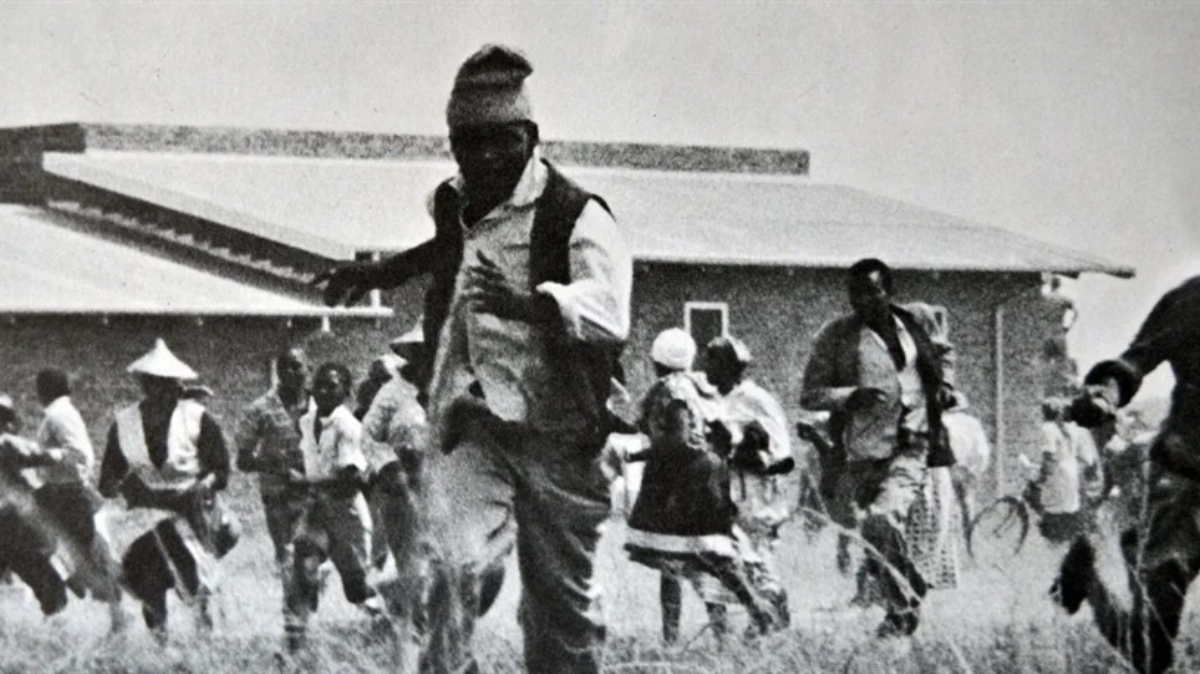
| 21 March 1960 | Police open fire on a pass law protest outside the Sharpeville police station |
| September 1960 | About 258 claims served on the Minister of Justice, seeking £400 000 |
| July 1961 | Indemnity Act passed, nullifying the claims |
| After 1961 | A committee recommends discretionary payments. About a third of claims receive sums totalling under 4% of the amount sought |
| 1996 onward | Truth and Reconciliation Commission hearings. No police officer applies for amnesty over Sharpeville |
| 3 September 2026 | High Court application filed to declare the Act unconstitutional |
Who is bringing the case
Three Sharpeville residents are acting as representative plaintiffs for a wider group.
Abram Mofokeng, 87, was 20 on the day. A bullet struck him in the foot and another lodged in his back, where it remains. Paulina Mathinye and Ishmael Poho both lost their fathers in the shooting when they were young children.
More than 70 survivors and relatives have expressed support for the litigation or interest in joining it.
Part of the application asks the court to certify a class action. If certified, it would be the first time dozens of survivors and descendants could bring a single claim together.
Charne Tracey, an attorney at Lawyers for Human Rights, said the plaintiffs want to open a dialogue with government about reparations, and understand they need a legal instrument to be heard. Beyond individual damages, she said, the community is seeking reparations to enable its healing. “They feel as though Sharpeville is a forgotten community,” she said.
Dan Leader, a partner at Leigh Day, has described the case as a reckoning for modern South Africa.
The numbers still do not agree
Apartheid-era police records put the toll at 69 killed and at least 180 wounded. Many were shot in the back as they fled.
Research cited by the plaintiffs puts it at a minimum of 91 killed and more than 238 wounded. That is a gap of at least 22 dead and 58 injured, unresolved 66 years on.
Tsoana Nhlapo, 47, a traditional healer and activist born and raised in Sharpeville, has argued that even those figures turn people into statistics, and that three decades of marking the date as Human Rights Day has obscured what happened.
Sello Theodore, 86, another survivor, put his position more simply. “My heart is painful and sore,” he said. His request is that the township, which is falling into disrepair, be cleaned up and its history preserved.
Mpai Chabane, 39, whose grandmother Martha Thinane was killed, said her mother was four years old when she lost her own mother, and that compensation is what justice would look like.
The community’s economic position is part of the claim, and it sits in a country where the second quarter unemployment figures show how little slack most households have.
What government says, and what is unresolved
The Department of Justice has told the BBC that it has supported victims of apartheid for many years and does not object to victims and their families pursuing legal remedies. It urged Sharpeville survivors and relatives who have not yet been identified to come forward.
Several things are unsettled. No hearing date has been set and the class action has not been certified. The government has not filed an answering affidavit, and the amount of compensation sought has not been made public.
The largest open question is one nobody has resolved publicly. Even if the Indemnity Act is struck down, claims arising from 1960 would ordinarily have prescribed, meaning they expired through the passage of time. How the court handles that, and whether the state elects to raise it, will decide whether the case reaches the merits at all.
The Truth and Reconciliation Commission route closed without answering Sharpeville. No police officer ever applied for amnesty for what happened there.
The application is now before the High Court. Nothing has been decided.