







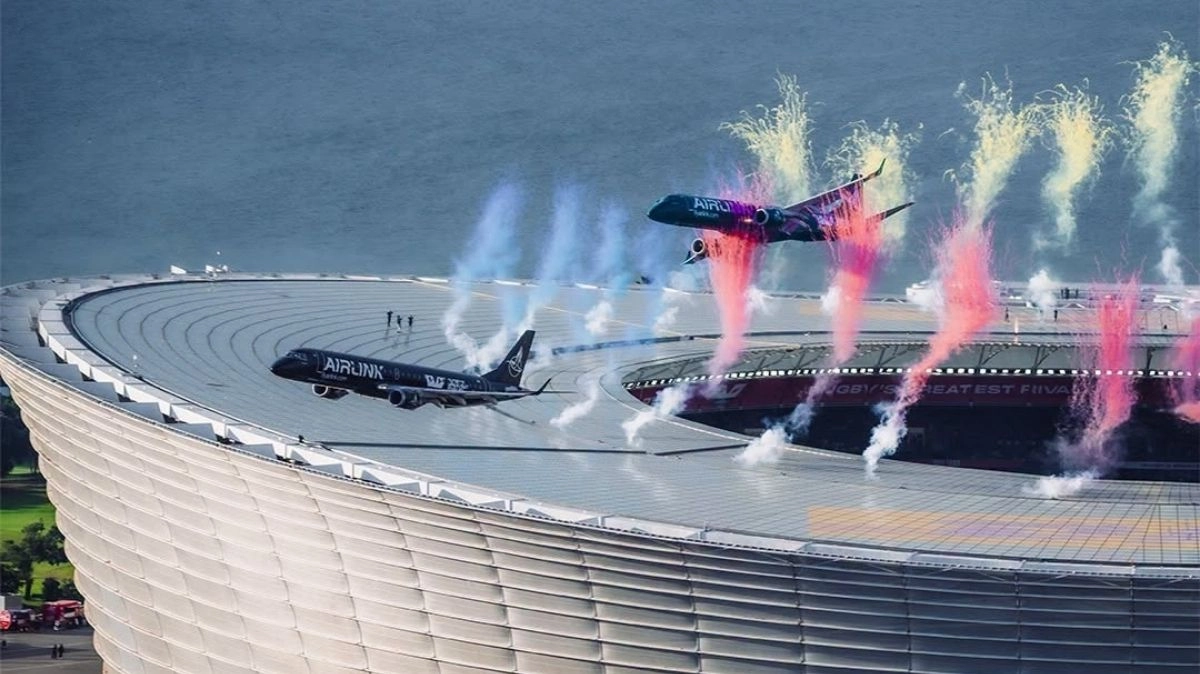
The Airlink stadium flyover that drew global attention on Saturday was not an unauthorised stunt. The South African Civil Aviation Authority approved it, and the regulator is now reviewing what it approved.
SACAA confirmed this week that it has obtained the flight data recordings from both aircraft, requested further information from Airlink, and will issue a full report with recommendations once the review is complete.
The reason it opened that review is the part that has gone unremarked. By its own account, SACAA began compliance verifications after discussions in the media, not because a safety report or incident triggered them.
For anyone going to FNB Stadium on Saturday for the deciding Test, the practical outcome is already settled. There will be no flyover.
Three applications, one pulled
Airlink submitted three flypast applications tied to the Springboks and All Blacks series. SACAA has confirmed all three were filed in line with the regulatory provisions governing non-passenger and non-cargo-carrying flights under Part 91.06.32, and were handled as a Special Air Event.
| Application | Date | Venue | Outcome |
|---|---|---|---|
| First | 22 August 2026 | Johannesburg | Approved and flown, no public controversy |
| Second | 29 August 2026 | DHL Stadium, Cape Town | Approved and flown, now under review |
| Third | 5 September 2026 | FNB Stadium, Soweto | Withdrawn by Airlink |
The first flypast passed almost unnoticed. The second did not.
Two Airlink Embraer regional jets in special Springbok and All Black liveries passed over Cape Town Stadium minutes before kick-off, in front of a crowd of about 56 000, at what observers and flight-tracking data put at roughly 12 metres above the roof. That is about 40 feet.
EWN reported that more than 94 000 fans expecting a repeat at FNB Stadium will not get one. SACAA has confirmed the third application was withdrawn.
The altitude question the regulator has not answered
Chris Martinus, president of the Aircraft Owners and Pilots Association of South Africa, set out the standard he says applies. “The normal level is 3 000 feet above an open-air assembly of persons,” he said.
Against that figure, the reported clearance over Cape Town Stadium was roughly 75 times lower.
Martinus said the risk of an accident was low, but that the size of the crowd meant any slip would have been serious. He said he hoped flypasts would continue at reasonable altitudes, and that this one could end a tradition rugby crowds enjoy.
SACAA has not published the altitude floor it approved for the event. It has not said whether the roughly 12 metre clearance fell inside the profile it authorised, and it has not indicated what, if anything, it considers to have gone wrong.
That silence is what leaves the central question open. If the pass was flown inside the approved envelope, the review is not about Airlink’s conduct. It is about the approval.
What Airlink says
The airline has been consistent. Airlink said the manoeuvre was planned and rehearsed, that SACAA and Air Traffic and Navigation Services provided guidance, approval and support, and that safety was the first consideration at every stage.
Each aircraft carried three senior captains, serving as commander, co-pilot and a dedicated safety and technical officer. Airlink put the combined flight hours across both crews at more than 75 000. Pilots also completed a safety briefing and a simulator practice flight, according to SACAA.
On the altitude itself, Airlink said flight data from both jets confirmed the passes stayed within the “approved and rehearsed safety altitude and speed limits for the flypast”.
The airline provided its flight data recorder downloads to the regulator earlier this week.
A split reaction, including in Cabinet
The flypast divided opinion inside government as well as outside it.
Public Works and Infrastructure Minister Dean Macpherson, who was at the stadium, defended the airline and dismissed the criticism from aviation experts as laughable. Sports Minister Gayton McKenzie praised the pilots and said he would ask them to land on the field next time.
SACAA has taken a different tone. The regulator pointed to South Africa’s record of no fatal accidents in commercial airline operations for more than four decades, said it intends to maintain that record, and said it was therefore critical to interrogate the weekend’s events with data at its disposal.
Flypasts are not new at South African sporting and presidential events, and have been flown by both military and commercial aircraft over the years. What is new is a commercial passenger jet operating this low over a full stadium.
What is still unresolved
Several things have not been established. SACAA has set no date for its report and has not said what enforcement options, if any, are on the table. It has not published the approved altitude and speed parameters, so no independent assessment of compliance is possible from the public record.
Neither SACAA nor Airlink has explained why the FNB Stadium application was withdrawn, or which party initiated the withdrawal. No finding of any breach has been made against Airlink.
The 12 metre figure comes from observers and flight-tracking data rather than from the regulator or the airline, and neither has confirmed it.
The third Test between the Springboks and the All Blacks kicks off at FNB Stadium in Soweto on Saturday 5 September, without an aerial display. SACAA’s report is expected after that.