









What we know so far
The Department of Home Affairs is pressing ahead with plans to phase out South Africa’s green barcoded ID book, with roughly 16 million still in circulation, Home Affairs Minister Dr Leon Schreiber said.
Schreiber was responding to questions at an Inter-Ministerial Committee on Migration media briefing on Sunday. The remarks were carried by the government news service SAnews on Monday, 15 June.
He described the green ID as the most defrauded piece of identity document in South Africa, adding that studies rank it the most defrauded on the African continent.
The Minister attributed the vulnerability to the document’s physical photograph. He said the photo can be manipulated, exchanged, or swapped if the ID is lost or stolen.
Schreiber also warned that artificial intelligence is giving criminal syndicates and undocumented foreign nationals new tools to manipulate identity documents.
“Our job is to replace those with secure smart IDs,” he said, referring to the green ID books still in use.
The trigger for the renewed focus is the Inter-Ministerial Committee briefing, where the green ID phase-out was framed as part of a wider migration and identity-security strategy.
Why it matters
The change affects an estimated 16 million South Africans who still rely on the green barcoded book as their primary proof of identity.
Identity documents underpin access to banking, credit, social grants, employment, and government services. A document widely described by the department as easy to forge therefore carries direct financial and security consequences for ordinary citizens.
The banking sector is a central concern. Identity theft linked to weak documents feeds fraudulent credit applications, loans, and account takeovers, exposing both consumers and lenders.
For the state, the green ID has become a pressure point in migration management. President Cyril Ramaphosa has said the document has been exploited by undocumented immigrants and criminal syndicates to facilitate identity theft.
The phase-out is being positioned as part of a broader effort to strengthen migration management while, in the government’s words, upholding constitutional values and human dignity.
Key details and figures
About 16 million green ID books remain in use across the country, according to Schreiber.
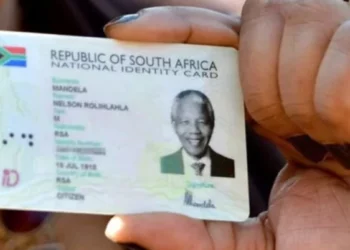
To accelerate the switch, Home Affairs has expanded its digital partnership with the banking sector. This allows people to walk into participating bank branches and apply to move from a green ID to a smart ID.
Schreiber said the service is now live in more than 178 bank branches nationwide, with many located in rural areas where access to Home Affairs services was previously limited.
The department is targeting 750 bank branches by the end of this year, the Minister said.
The rollout has scaled quickly. In a separate SAnews release dated 15 May, Home Affairs reported that 167 bank branches were offering smart ID replacement services within eight weeks of the partnership launch, with 118,434 applications already processed through the new system.
In that earlier update, the department said the bank application process had been fully digitalised, allowing eligible applicants to apply in as little as five minutes without bookings or paperwork.
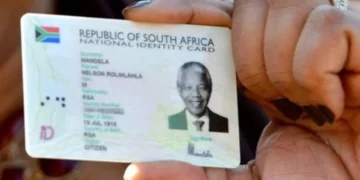
The smart ID card carries stronger security features than the green book, including biometric verification, which the department says removes the manual discretion that exposed the older document to manipulation.
What happens next
The government has signalled a deeper overhaul of the national identity system beyond the branch expansion.
In an announcement made the week before the briefing, government said it would establish an Intelligent Population Register containing biometric data for every person in South Africa.
It also said it would introduce new regulations to prevent the misuse of Traffic Registration Numbers, which are issued to foreign nationals and have been linked to identity fraud.
Home Affairs is separately developing a Digital Identity system that the Minister has described as foundational national infrastructure for the digital economy. Draft regulations under the Identification Act were published for public comment, with submissions having closed on 6 June.
The proposed digital system is intended to let citizens access Home Affairs services and authenticate their identity remotely using smartphones.
Several questions remain open. The government has not announced a fixed date on which green ID books would cease to be valid, describing the move instead as a progressive phase-out.
It is also not yet clear how the department will reach the millions of holders in areas without nearby participating bank branches, or how quickly the 750-branch target will translate into reduced green ID usage.
For now, green ID books remain valid, and holders are being encouraged to switch to the smart ID through Home Affairs offices or participating bank branches as the network expands.