






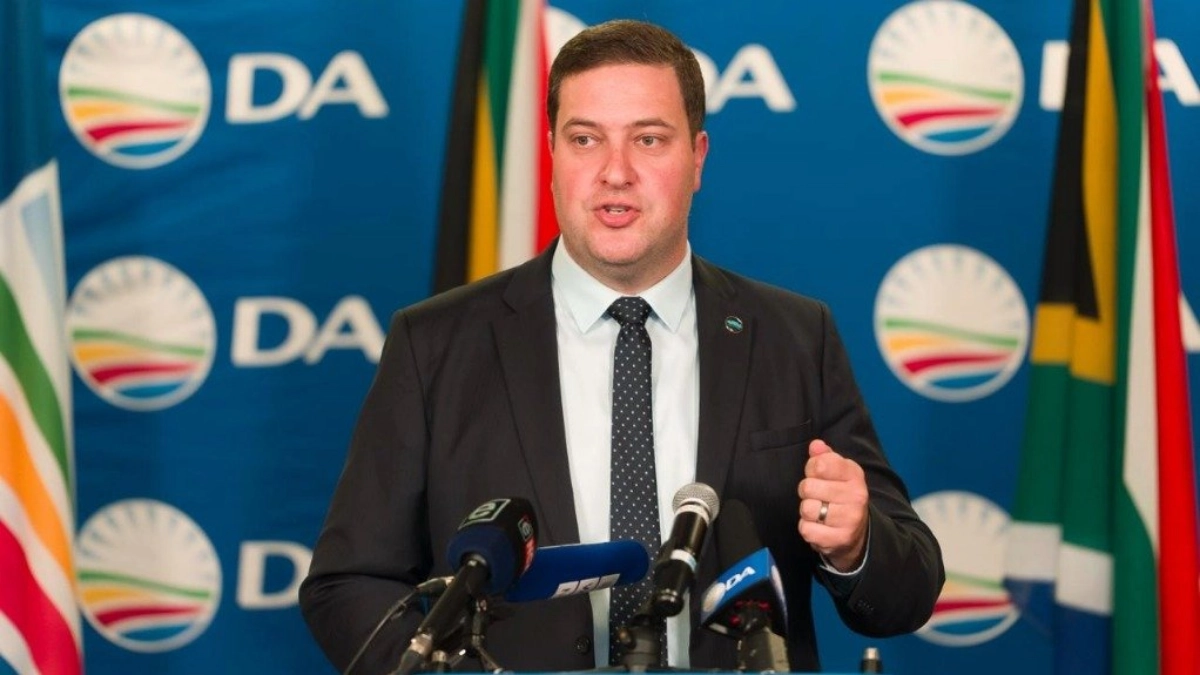
The Democratic Alliance is taking its campaign to replace Black Economic Empowerment in public procurement to Parliament, where its proposed Economic Inclusion for All Bill is set for a first reading debate on Thursday. The DA says the bill would shift empowerment away from race-based procurement criteria and toward a preference-points system built around outcomes such as job creation, infrastructure investment, skills development and support for small business.
The stronger and more accurate angle here is not that South Africa has already decided to scrap BEE. It has not. What is happening now is that the DA’s proposal is moving through Parliament as a private member’s bill, which means the party is trying to change the law, not announcing a policy change that has already been adopted by government.
That distinction matters because the DA’s public branding and the formal bill are not identical. The party calls the proposal the Economic Inclusion for All Bill, but Parliament lists it as the Public Procurement Amendment Bill (B7-2026), introduced on 12 March 2026 by DA MP Mat Cuthbert. Parliament’s summary says the bill would repeal provisions linked to set-asides and prequalification criteria for preferential procurement, and would also repeal the Broad-Based Black Economic Empowerment Act, 2003, with consequential amendments.
What we know so far
The clearest current development is procedural. Parliament’s weekly programme says the National Assembly will convene concurrent mini-plenary sittings on Thursday for first reading debates on four bills, including the Public Procurement Amendment Bill and the Public Procurement Second Amendment Bill. That means the DA’s proposal has moved beyond party messaging and into an actual parliamentary step.
The DA’s own statement on 6 May says this first reading marks what it sees as a major step in changing South Africa’s empowerment policy. In that statement, the party argues that redress remains necessary, but says BEE has failed to produce meaningful inclusion and instead benefits a politically connected few. Those are the DA’s claims, not an established legal finding, but they explain the political case the party is now trying to make in Parliament.
The bill itself is focused heavily on procurement. Parliament’s formal description says it would amend the Public Procurement Act, 2024, including by repealing provisions related to preferential procurement, subcontracting as a condition to bid, some local-content provisions, and the BBBEE Act. The memorandum attached to the bill says its objective is to replace race-based classifications in preferential procurement with a framework aligned to Sustainable Development Goals and broader socio-economic outcomes.
That context is important because the proposal is not framed as a general rewrite of every empowerment instrument across the economy overnight. In the public record reviewed, it is centred on the state procurement system and the rules used to allocate preference in government contracting. The DA says that is where reform could have the biggest practical effect because public procurement remains one of the state’s most powerful economic levers.
Why it matters
This matters because procurement policy sits at the heart of how the state spends money and advances public goals. When President Cyril Ramaphosa signed the Public Procurement Bill into law in July 2024, the Presidency said the legislation was intended to create a single framework for public procurement, including preferential procurement, across organs of state. In other words, the fight the DA is opening now is not about a side issue. It is about one of the main legal frameworks through which South Africa links public spending to transformation and accountability.
There is also a timing issue that gives the bill added significance. National Treasury said in August 2024 that the Public Procurement Act had been signed and gazetted, but that its provisions were not yet in force and would only commence once the President proclaimed the relevant sections and supporting regulations were ready. Treasury also said the old procurement framework would remain in place until the new act and accompanying regulations took effect. That means the DA is trying to amend a major procurement law before it is fully operational.
The DA’s argument is that South Africa should reward companies for measurable social and economic outcomes rather than race-based compliance. In its 6 May statement, the party says firms would gain preference for creating jobs, building infrastructure, developing skills and helping small businesses grow, while tougher anti-fraud rules would be used to strengthen accountability. The memorandum to the bill similarly says the proposal is meant to build a race-neutral but socio-economically progressive alternative procurement framework.
But the countervailing reality is that BEE and preferential procurement are rooted in South Africa’s constitutional and political commitment to redress. The DA itself acknowledges in its latest statement that redress remains a national imperative. That is why this bill is likely to be politically contentious even before the legal detail is fully argued. It is not just a technical procurement amendment. It is a challenge to one of the country’s most contested post-apartheid policy tools.
Key details and figures
Several details stand out in the current record. The DA says the proposal targets the state’s roughly R1.2 trillion procurement budget, which it describes as one of the most powerful tools for economic inclusion. Parliament’s bill page confirms the formal title, bill number and date of introduction, and the weekly programme confirms that the first reading debate is scheduled for Thursday.
The bill’s formal objective is broader than a slogan about “ending BEE”. Parliament’s summary says it would repeal parts of the Public Procurement Act related to preferential procurement and also repeal the Broad-Based Black Economic Empowerment Act, 2003. The memorandum says the bill would replace race-based classifications in procurement with an approach tied to Sustainable Development Goals and socio-economic indicators.
Another important detail is that the proposal comes from the opposition benches, not from the executive. Parliament lists the bill as introduced by Mat Cuthbert, MP. That means the legislation still faces a high political threshold if it is to move beyond debate into committee scrutiny, broader support and eventual passage. First reading is a real milestone, but it is only the start of the parliamentary process, not the end of it.
The DA has been building toward this moment for months. Its earlier statements said the bill had been introduced in March and previously gazetted in 2025. The party’s own scorecard for the proposal says it wants procurement preference to be based on actual disadvantage and measured social impact rather than race. That continuity matters because it shows the 6 May announcement is not a one-day headline stunt but part of a longer legislative push.
What happens next
The immediate next step is Thursday’s first reading debate in the National Assembly mini-plenary. That debate will not settle the future of BEE, but it will formally place the DA’s alternative on Parliament’s agenda and begin testing whether the party can build any support for it beyond its own benches.
After that, the bigger question will be whether the proposal develops into a serious multi-party legislative contest or remains primarily a DA policy marker. The legal and political stakes are high because the proposal reaches into public procurement, preferential policy and the future of how the state defines economic redress. For now, the most accurate conclusion is narrow and factual: the DA wants to replace BEE-linked procurement rules with what it calls economic inclusion for all, and that argument is now moving into Parliament in the form of a first reading debate on its bill.