











It started with a set of Land Rover tyres.
Inshaan Omar had been buying tyres from the same shop for the better part of 20 years. When his Discovery needed a new set, he did what any cost-conscious driver would do and asked whether there were any specials running.
There weren’t, so he waited.
Six weeks later, with the tyres now genuinely worn, he returned and paid full price. Only at the counter did the assistant casually mention that, had he come in a week earlier, he would have qualified for a Buy 3, Get 1 Free promotion.
On four Land Rover tyres, that was not a small saving to miss.
What stayed with Omar was not only the lost discount. It was the absurdity of the situation.
“I’d been buying tyres from these guys for twenty years,” he says. “They knew I was a customer. I was interested in their product. They had exactly the promotion I wanted, at almost exactly the time I wanted it, and somehow we still missed each other.”
The customer wanted to buy. The business wanted to sell. The interest existed on both sides.
But the connection didn’t.
Omar went looking for an app that could show him promotions for the products and services he actually cared about, when those offers became available.
He couldn’t find one.
That gap eventually became Addex.
A System Businesses Have Learned to Tolerate
Omar is not a career technology founder.
He qualified as a Chartered Accountant (SA) more than 20 years ago, but spent little time in traditional accounting. He moved into banking early in his career and spent most of it trading spot currency for a tier-one South African bank.
Just before COVID, he left banking to start a currency hedge fund with a partner. The timing could hardly have been worse. Markets were turned upside down and the fund was eventually wound down.
For the first time in years, Omar found himself paying much closer attention to his own spending, including promotions, discounts and special offers.
The more he looked, the more he realised the tyre incident was not unusual.
Businesses were spending heavily to reach customers. Consumers were surrounded by advertising. Yet the two still routinely failed to connect at the moment it mattered most.
For millions of businesses, digital advertising has become increasingly difficult to avoid.
Businesses boost social media posts because organic reach is limited. They bid on search keywords against competitors with significantly larger budgets. They pay to reach broad audiences while knowing that many of the people who see those advertisements will never be interested.
Some businesses perform exceptionally well with digital advertising.
Many do not.
In the absence of a credible alternative, however, most businesses have simply accepted that this is how digital advertising works.
For much of the past two decades, that has largely been the status quo.
Exceptional Platforms, Unequal Outcomes
“The issue isn’t that Google and Meta have failed,” Omar says. “They’ve built exceptional businesses. The issue is that their success doesn’t mean the system works equally well for every business using it.”
Google is built around search and performs particularly well when customers already know what they are looking for.
Meta is built around attention, giving businesses access to enormous audiences across its platforms.
Both models serve a purpose. They also naturally serve the commercial interests of the companies that created them, with systems designed to increase engagement, advertising demand and revenue rather than guaranteeing every small business an equal opportunity to reach customers.
That is not necessarily a criticism. It is how successful commercial platforms operate.
South Africa’s Competition Commission has also examined the imbalance within parts of the digital advertising market.
Its Online Intermediation Platforms Market Inquiry described Google Search as a “critical gateway to consumers” and found that the positioning of paid search alongside organic results tended to favour larger, more established businesses.
The Commission’s later Media and Digital Platforms Market Inquiry highlighted just how concentrated parts of the market had become. In the data examined by the Commission, Google accounted for 99.2% of paid search advertising, while Meta held 71% of paid social advertising.
When visibility has to be bought, businesses with the deepest pockets often have an obvious advantage.
For a small independent business competing against national brands, that can make gaining meaningful exposure considerably harder.
Turning the Relationship Around
Omar and his team began with a difficult question:
How could advertising become affordable, inclusive of smaller businesses, genuinely targeted, relevant and actually welcomed by customers, while also alerting people to offers and promotions they care about?
Their answer was deceptively simple.
Turn the relationship around.
Instead of the business starting with the question, “Who can we target?”, the customer begins by saying:
“This is what I’m interested in.”
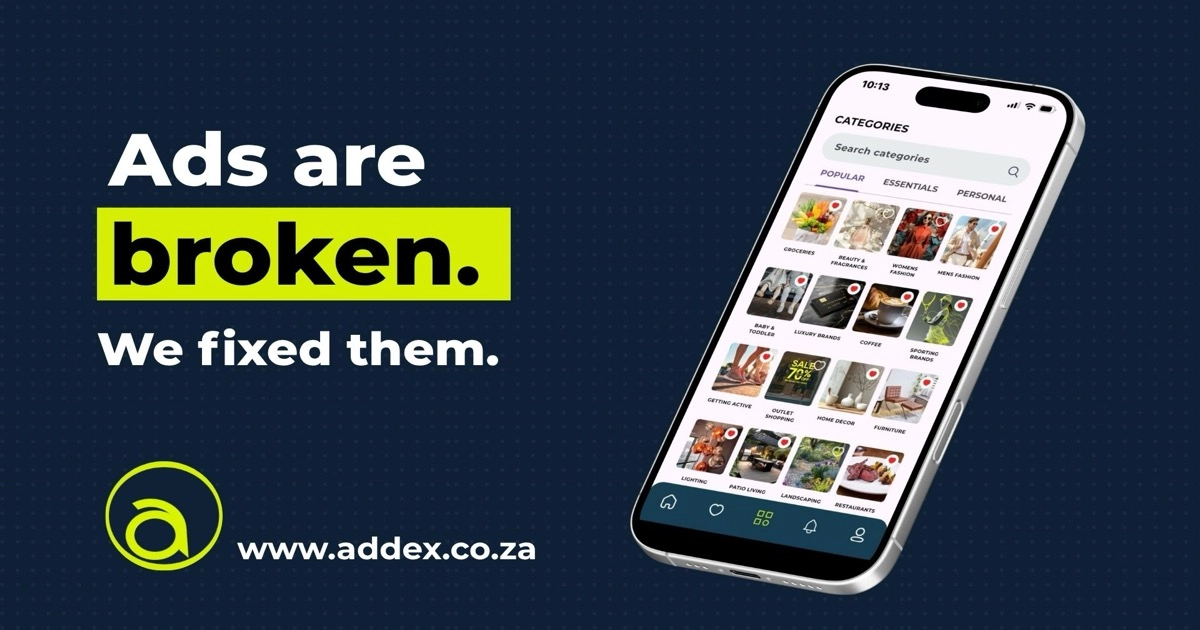
Consumers using Addex can select from more than 160 categories that matter to them.
When a business runs a promotion through Addex, the offer can then be matched with people who have already indicated that they are interested in that particular category.
For businesses, the proposition is a more direct route to relevant consumers who are genuinely open to discovering what they offer.
The goal is better targeting, lower costs and less wasted advertising spend.
“We believe there’s room for something that starts with the interests of the customer and creates value for the business from there. That way advertising works better for everyone,” Omar says.
The Businesses People Don’t Know to Search For
Declared interest also creates another opportunity: discovery.
Many consumers know exactly what they want and simply search for it.
The problem is that people cannot search for businesses they do not know exist.
“Across South Africa are remarkable businesses that many people will never know about because they don’t rank on search results or will never hit your social feeds, like the tailor in Fordsburg creating fitted suits from Italian Super 120s wool for R5,500, or the home baker who’s spent nearly three decades perfecting the most delectable pastries.
“There are independent restaurants, artisans, specialist retailers, family businesses and local experiences sitting only a few kilometres away from people who would probably love what they offer. They just lack the visibility,” says Omar.
For Addex, this is one of the opportunities created by an interest-led platform.
Instead of relying entirely on someone knowing a business by name or seeing the right advertisement at the right moment, businesses can potentially appear in front of consumers who have already declared an interest in what they sell.
Built, But Not Yet Proven
Addex is not an overnight build.
Around two years ago, Omar partnered with Dinesh Naidoo, now the company’s CTO, who had previous experience taking products to market.
The pair bootstrapped the company, encountered expensive lessons with early development partners and even paused development when funding ran short before eventually pushing ahead.
Today, the consumer app is live on the Apple App Store and Google Play.
The advertiser platform, business dashboard and analytics systems have also been built.
Technically, Addex is ready.
Commercially, however, it remains unproven.
There are currently around 1,200 businesses on the platform, most of which were seeded by the Addex team.
Omar does not try to disguise how early the company still is.
“We’re very early. We’ve built the technology, but technology alone doesn’t create a marketplace. Now we need the businesses we built it for to help us prove the model can work.”
A National Platform Starting With Gauteng
Every two-sided marketplace faces the same problem.
Consumers are more likely to use a platform when there are enough businesses and offers available. Businesses are more likely to participate when there are enough consumers using it.
Each side effectively waits for the other to arrive first.
Addex’s strategy is to build density in one market rather than spreading its initial efforts too thinly across the country.
That first market is Gauteng.
The province offers a concentrated environment where consumers can repeatedly discover useful businesses while participating businesses have a better opportunity to generate meaningful engagement.
Once that cycle is established, Addex plans to expand its concentrated acquisition efforts to Cape Town and Durban.
That does not mean businesses elsewhere in South Africa have to wait.
Addex is available nationally from day one, and its Founding Business invitation is open to qualifying businesses across South Africa.
Businesses outside Gauteng can join now, secure Founding Business benefits and build their profiles ahead of more concentrated campaigns in their regions.
Businesses that sell online, deliver nationally or serve customers remotely can also participate regardless of location.
Gauteng businesses will simply be the first to benefit from Addex’s concentrated local acquisition strategy.
“Once the model works in one market,” Omar says, “the question changes from ‘Will this work?’ to ‘How far can we take it?’”
Addex Is Looking for Its First 100 Founding Businesses
Addex is inviting its first 100 qualifying businesses to join the platform as Founding Businesses.
The programme is aimed at businesses familiar with many of the frustrations Addex wants to address, including:
- Businesses that have watched advertising costs rise without seeing better results
- Retailers paying to reach their own followers
- Independent businesses being outspent by national brands
- Advertisers that have wasted budget targeting the wrong audiences
- Strong local businesses that still struggle to get discovered
For Addex, Founding Businesses are intended to do more than simply run advertisements.
They will help test whether smaller businesses can gain visibility without enormous budgets, whether promotions can more effectively reach people who actually want them and whether consumers can receive useful alerts before relevant offers expire.
Most businesses naturally wait for a new platform to prove itself.
But proof can only be created by businesses willing to participate early.
Addex is therefore looking for companies willing to challenge the idea that the current digital advertising model is the only option.
While Gauteng is its first concentrated market, qualifying businesses anywhere in South Africa can join and secure their position early.
“This isn’t just a launch incentive,” Omar says. “It’s about sharing value with the businesses helping to create it.”
The Reward for Getting There First
Addex is offering several benefits to qualifying Founding Businesses that join during its early rollout.
Every Founding Business receives:
- A free lifetime national listing, currently valued at R3,600 per year
- R20,000 in Addex advertising credits to promote offers as the platform’s audience grows
- Early presence within their category before competition increases
- A direct role in shaping the platform they may be advertising on for years to come
In return, Addex asks participating businesses to actively contribute to building the marketplace.
“In return, we ask for the things that bring a marketplace to life: create a real profile, run genuine promotions, and share Addex with the customers and followers you already have,” says Omar. “That’s how it comes alive, from both sides at once.”
His invitation to businesses is simple:
“You’ve felt what’s broken. This is your chance to help fix it, and to be first in line when it works.”
Become a Founding Business
Businesses interested in joining Addex as a Founding Business can register through the platform:
Businesses can also contact Inshaan Omar directly at [email protected].
For Consumers
Consumers can download Addex from the Apple App Store or Google Play.
Users choose the categories that matter to them, receive alerts about relevant promotions and can discover businesses they may otherwise never have known to search for.
Tell Addex what you’re interested in. Discover what you’ve been missing.
DOWNLOAD ADDEX → Apple App Store | Google Play