





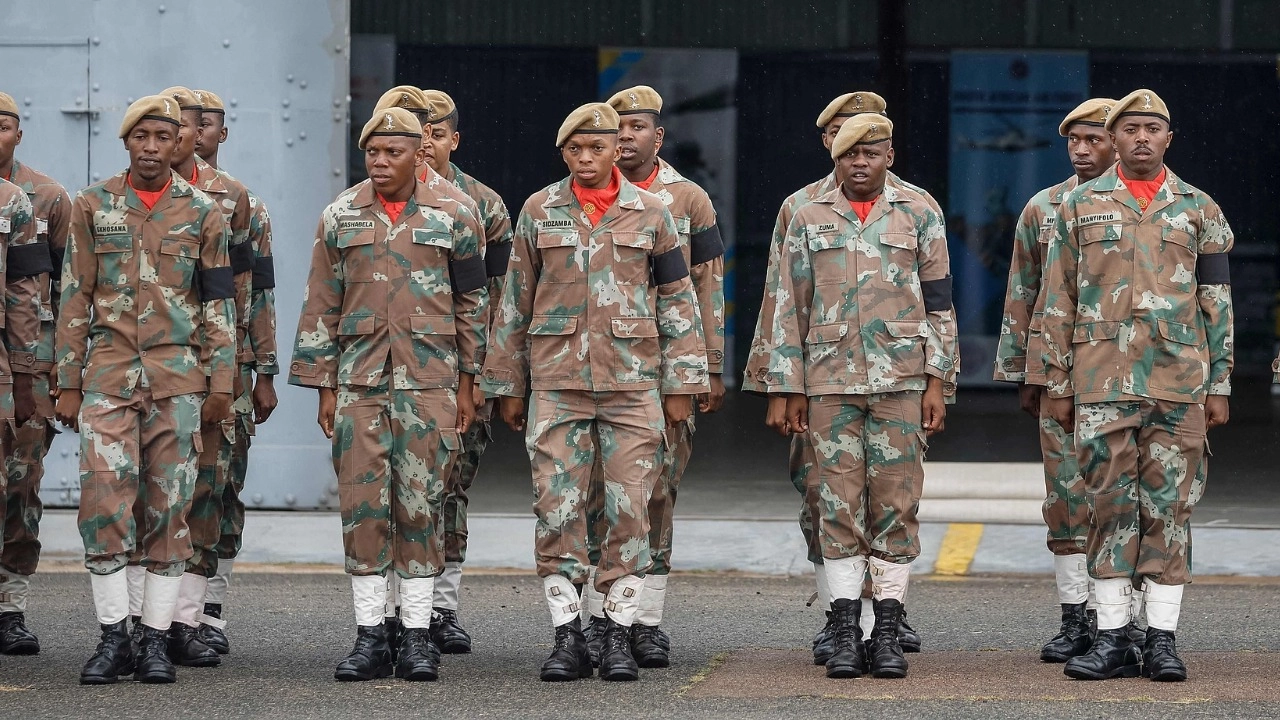
President Cyril Ramaphosa has formally authorised the deployment of 2,200 members of the South African National Defence Force to support the police in fighting crime, at an estimated cost of R823,153,960. According to the Presidency, the operation runs from 1 March 2026 to 31 March 2027 and will target illegal mining and gangsterism in the Eastern Cape, Free State, Gauteng, North West and Western Cape.
The size of the bill makes this one of the most significant recent domestic security deployments involving the military. What began as a pledge in Ramaphosa’s 2026 State of the Nation Address has now become a long-duration, multi-province operation that places the army directly alongside the South African Police Service in some of the country’s most violent hotspots.
What the R823 million actually means
The headline number is large, but its significance becomes clearer when broken down over time. Based on the Presidency’s cost estimate and the stated deployment period, the operation works out to roughly R2.08 million a day across the full deployment window, or about R374,161 per deployed member over the life of the operation. That is an inference from the Presidency’s own figures, but it shows the scale of the state’s decision to use military support in a civilian anti-crime campaign.
This is also not a blanket nationwide deployment. The government has framed it as a targeted intervention under Operation Prosper, aimed specifically at organised crime linked to illegal mining and gang violence. That matters because the cost is being justified not as a standing military role in policing, but as a focused response to criminal networks that government says ordinary policing has struggled to contain on its own.
Where the troops are being sent
The Presidency’s notice names five provinces, but the crime focus is not the same in each one. According to reporting on details submitted to Parliament, the deployment will concentrate on illegal mining in Gauteng, North West and the Free State, while gang violence is a key focus in the Western Cape and Eastern Cape. That split is important because it shows government is responding to two different criminal pressures under one deployment framework rather than treating all provinces as part of the same security problem.
In Gauteng, the operation has already started taking visible form. SAnews reported that the Gauteng leg of the operation, focused particularly on areas around Johannesburg’s West Rand and East Rand, is expected to cost about R80.7 million on its own. That gives a sense of how quickly the numbers scale up once the deployment expands from a provincial hotspot intervention into a full five-province operation.
Why Ramaphosa says the deployment is necessary
Ramaphosa has tried to root the decision in a broader national crime strategy rather than present it as a stand-alone military response. In his 2026 State of the Nation Address, he said organised crime had become “the most immediate threat” to South Africa’s democracy, society and economic development, and announced that the SANDF would be deployed to support police against gang violence and illegal mining. In a later weekly public letter, he said the deployment had become necessary because of a surge in violent organised crime that threatens both public safety and the authority of the state.
That broader framing matters because it turns the troop deployment into a political signal as much as a policing decision. It says government believes organised crime has moved beyond being a conventional law-enforcement problem and now requires a show of force, extra manpower and a more integrated state response. Cabinet echoed that line in late February, saying the fight against organised crime is being reinforced through SANDF deployment in gang-ridden hotspots and other reforms inside the criminal justice system.
For readers who want the original official wording, the Presidency’s deployment notice sets out the troop number, provinces, timeframe and exact cost. That official statement is the clearest base document for the story and makes plain that Parliament was informed in terms of section 201 of the Constitution.
What this says about the state of crime fighting
The deployment is also an implicit admission that government believes the police need reinforcement in some of the country’s most dangerous operating environments. Associated Press reported that authorities previously indicated the police service alone lacked sufficient capacity to deal effectively with heavily armed criminal syndicates operating in illegal mining networks, and that the army would work under police command. That is a significant point, because it places the military in a support role while still highlighting limits in ordinary policing capacity.
The backdrop is a country still dealing with very high levels of violent crime. AP reported that police recorded 6,351 homicides between October and December 2025, an average of nearly 70 a day. That figure does not by itself explain the troop deployment, but it helps explain why government is willing to spend more than R823 million on an intervention it hopes will show visible force in places where criminal syndicates have become entrenched.
What taxpayers should watch
The deployment cost will not sit in isolation. Cabinet said in February that, to support the fight against crime, the 2026 Budget added R2.7 billion over the medium term to the defence budget to improve operations, while an additional R1 billion each was allocated to SAPS and the SANDF from the Criminal Assets Recovery Account to fight organised crime. That means the troop surge should be read as part of a much wider anti-crime spending push rather than a once-off security expense.
That makes the accountability question more important. If South Africa is committing hundreds of millions of rand to a troop-backed crime operation, the real measure will not be the troop count or the visibility of patrols. It will be whether the operation disrupts syndicates, lowers violence in targeted areas, improves arrests and prosecutions, and leaves police in a stronger position when the deployment period ends. At more than R823 million, this is expensive enough that the public return will need to be more than a short burst of visibility.
A short timeline
12 February 2026: In his State of the Nation Address, Ramaphosa says the SANDF will be deployed to support police against gang violence and illegal mining.
25 February 2026: Cabinet says the anti-organised-crime strategy is being reinforced through SANDF deployment in gang-ridden hotspots and additional crime-fighting funding.
13 March 2026: The Presidency announces that 2,200 SANDF members will be deployed in cooperation with SAPS across five provinces at an estimated cost of R823,153,960.
What happens next
The next phase is likely to be judged on outcomes rather than symbolism. Government has already made the political case for the deployment, and the constitutional paperwork has been done. The harder question is whether a 13-month, R823 million operation can make a measurable dent in illegal mining syndicates and gang violence in the selected provinces.
For now, the clearest takeaway is this: South Africa’s anti-crime troop surge is no longer just a SONA promise. It is a fully authorised, time-bound and expensive security intervention, and taxpayers will now be watching to see whether more than R823 million buys a safer result.