










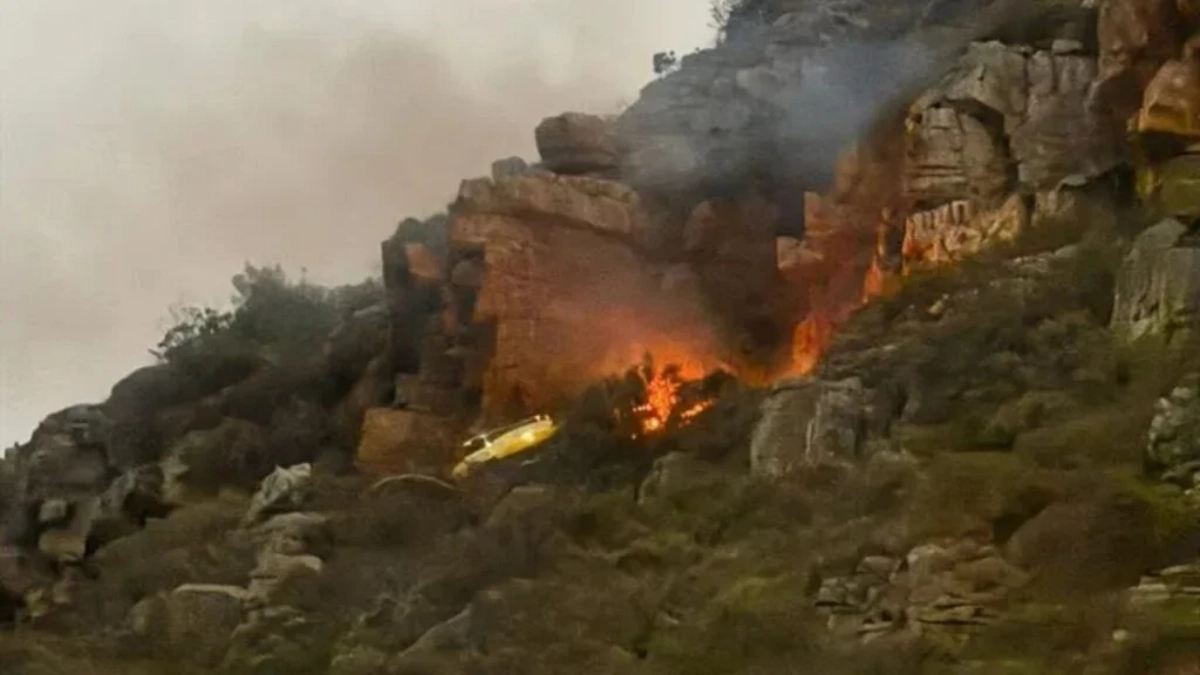
A firefighting helicopter crashed on the slopes above Hout Bay while trying to suppress a wildfire in Table Mountain National Park, but the pilot survived and was taken to hospital with minor injuries. South African National Parks said the incident happened on the evening of 25 March 2026 and triggered an emergency medical response as well as the activation of Wilderness Search and Rescue.
The incident matters because it unfolded during active fire suppression in steep, high-risk terrain above Cape Town, where aircraft are often used to support crews working on inaccessible mountain slopes. It also matters because the crash is now part of a formal aviation investigation, with early reporting indicating the aircraft may have struck the mountainside during operations. What happens next is now in the hands of investigators from South Africa’s aviation accident system, while wildfire teams continue monitoring the broader fire response in the area.
What we know so far
SANParks confirmed on 25 March that a helicopter operating at the fire site on the slopes of Hout Bay in Table Mountain National Park was involved in an incident. The agency said the pilot was safe and that emergency teams on site included WSAR, SANParks, Kishugu Aviation, Netcare24, the City of Cape Town Fire and Rescue Services and law enforcement personnel. SANParks added that investigations were under way and said it could not provide more comment at that stage.
Subsequent reporting added more detail on the aircraft and the injuries. SABC reported, citing Working on Fire managing director Trevor Abrahams, that the pilot exited the helicopter and was moved to hospital for observation with only minor injuries. IOL later reported that the pilot was the sole occupant on board and had been injured and transported to hospital.
There was also an important contractual clarification from government. The Department of Forestry, Fisheries and the Environment said the helicopter involved was part of the service provider network linked to the Working on Fire programme, but that this specific incident was not connected to the department’s contract. According to DFFE, the aircraft was doing private work at the time and was operating under a separate arrangement with SANParks.
That distinction matters because early public discussion blurred the line between Working on Fire’s broader state-linked firefighting role and the specific contract under which this helicopter was flying. DFFE said the pilot survived, received medical attention, and according to the service provider’s initial account, exited the aircraft unaided before making his way to safety.
Why it matters
The crash is significant not only because of the visual drama of a helicopter going down into an active fire zone, but because aerial firefighting is one of the most hazardous forms of flying. Helicopters working over mountain fires operate close to terrain, often in turbulent air, reduced visibility, heat and smoke, while repeatedly carrying out water-drop manoeuvres in narrow spaces. The Hout Bay incident is therefore a reminder of the risk carried by pilots and firefighting crews during wildfire season in the Western Cape.
The survival of the pilot has also become a central part of the story. SANParks initially said the pilot was safe, and later reporting from SABC and other local outlets described the injuries as minor. That combination of a severe crash, steep terrain and a non-fatal outcome explains why several local reports described the escape as remarkable.
There is also a broader operational point. Cape Town’s mountain fires often require a coordinated response from multiple agencies, including SANParks, the City of Cape Town, Volunteer Wildfire Services, WSAR, private aviation operators and medical responders. When one aircraft goes down during an active operation, it affects not only safety but also firefighting capacity at a time when air support can be critical to containing the blaze.
Key details and figures
Several verified details now frame the incident:
- The crash happened on 25 March 2026 on the slopes above Hout Bay in Table Mountain National Park.
- SANParks said the pilot was safe and that WSAR and emergency medical responders were activated.
- DFFE said the helicopter was undertaking private work and was operating under a SANParks contract, not under DFFE’s own Working on Fire contract.
- SABC reported that the pilot survived and was taken to hospital for observation with minor injuries.
- IOL reported that the pilot was the sole occupant on board.
- IOL, citing the Accidents and Incidents Investigations Division, said the aircraft was a Bell UH-1H and that it had taken off from the Newlands fire base before striking the mountainside.
- The same report said investigators expected to produce a preliminary report within 30 days.
These details are important because they establish that the event has moved beyond eyewitness footage and viral clips. The incident is now a documented aviation accident involving a named aircraft type, a formal emergency response, a clarified contract position and an active investigation.
Timeline
25 March 2026
A wildfire operation was under way above Hout Bay in Table Mountain National Park when the helicopter was involved in an incident. SANParks said emergency medical services and WSAR were activated and that the pilot was safe.
Later on 25 March
SABC reported that the aircraft was operated by Working on Fire and that Trevor Abrahams said the pilot had exited the helicopter and was moved to hospital for observation.
26 March 2026
DFFE clarified that the aircraft was not flying under the department’s own wildfire contract, but under a separate SANParks arrangement. The department said the pilot had exited unaided and was taken to hospital for medical evaluation.
26 March 2026
IOL reported that the AIID had launched an investigation, said the pilot was the sole occupant, and indicated that preliminary findings were expected within 30 days.
What officials and investigators are saying
SANParks has taken a restrained public line, confirming the incident, the pilot’s safety and the emergency response while declining to speculate on what caused the crash. That is consistent with its statement that investigations are under way and that it cannot offer additional comment at this stage.
DFFE has focused on correcting the contractual record. Its statement did not attempt to explain the cause of the accident, but made clear that the helicopter was not flying under the department’s own contract at the time. It also commended the emergency and wildfire personnel involved and said the relevant aviation and law-enforcement authorities were expected to investigate.
The clearest early description of the crash sequence so far has come through reporting on the AIID response. According to IOL, investigators said the Bell UH-1H struck the side of the mountain, leading to a loss of control and the eventual crash. That account is still preliminary and should not be treated as a final finding on cause.
What happens next
The next formal step is the aviation investigation. South Africa’s accident investigators have reportedly dispatched a team to collect evidence and secure the wreckage, with a preliminary report expected within 30 days. That process is important because it will separate verified operational facts from the flood of online commentary that usually follows dramatic aviation incidents.
On the wildfire side, SANParks said it would continue to monitor the situation and provide updates. That means the broader fire response remains a live operational issue even after the crash itself. In practical terms, authorities are now managing two linked events at once: the mountain fire and the aviation accident that occurred during the effort to contain it.
For now, the most important verified fact is this: a helicopter crashed while helping fight a fire above Hout Bay, the pilot survived, and investigators are now working to determine exactly what went wrong. In a wildfire season where aerial support can make a decisive difference, that is a major incident for Cape Town’s firefighting system even without loss of life.