






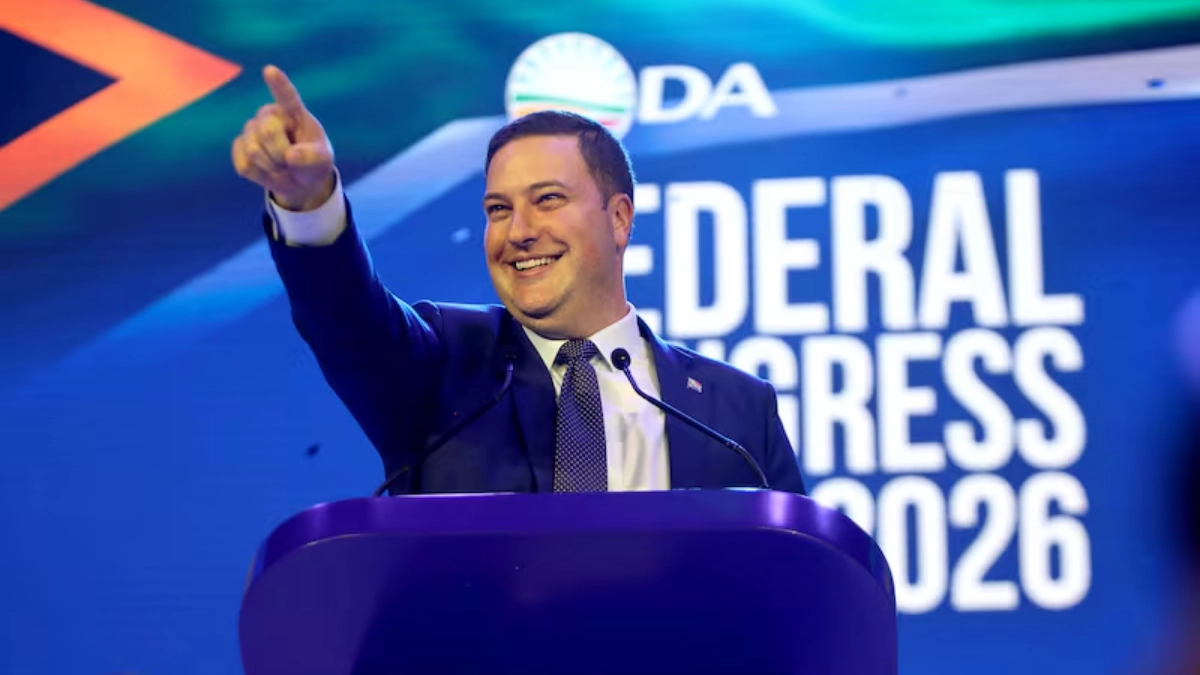
Geordin Hill-Lewis has been elected as the Democratic Alliance’s new Federal Leader, taking over from John Steenhuisen at the party’s 2026 Federal Congress. In the DA’s published acceptance speech, Hill-Lewis described himself as the party’s “newly elected leader” and said he would dedicate himself to “building a stronger South Africa for everyone.”
The leadership change matters because the DA is no longer operating only as an opposition party. It is a major force inside South Africa’s Government of National Unity, and Hill-Lewis now takes charge at a time when the party is trying to balance coalition participation with its longer-term ambition to become the country’s leading governing party. In his speech, he made that ambition explicit, saying the mission assigned to him was “to grow the DA into the largest party in South Africa” and “to lead a new national government.”
The stronger and more accurate angle here is not just that the DA has a new face at the top. The real significance is that Hill-Lewis used his first speech as leader to set out a direct political goal: to move the DA from being a party that can oppose and govern in parts of the country to one that can ultimately lead nationally.
What we know so far
The official DA source is now clear. The party published Hill-Lewis’s acceptance speech on 12 April 2026 under the heading “DA Federal Leader Acceptance Speech: Strong Enough to Win,” identifying him as “Democratic Alliance Federal Leader” and stating that the speech was delivered at the DA’s Federal Congress 2026. In the text itself, Hill-Lewis says: “I stand before you as your newly elected leader.”
That official source strengthens the public record considerably. Earlier reporting from the congress had already said Hill-Lewis defeated Sibusiso Dyonase and succeeded Steenhuisen, but the DA’s own published speech now confirms that the election outcome was formalised inside the party’s congress process. EWN reported that the election took place at the Gallagher Convention Centre in Midrand and that Hill-Lewis would lead the organisation for the next three years.
The speech also places his election inside a broader DA leadership lineage. Hill-Lewis used the address to praise former leaders including Tony Leon, Helen Zille, Mmusi Maimane and John Steenhuisen, arguing that each leader built something the next generation could build on. He credited Steenhuisen in particular with leading the DA into national government for the first time in its history through the Government of National Unity.
Why it matters
What changes the story most is that Hill-Lewis did not use his acceptance speech only to celebrate victory. He used it to outline a political programme. He said the key question facing the DA is no longer whether it can oppose or govern, but “whether the DA can lead the country.” He answered that question with what he called a “resounding yes.”
He then set out a four-point plan for how the party intends to win. First, he said the DA must continue to show that it governs well for everyone, arguing that where the party governs, “the basics work.” Second, he said the party must connect more deeply with millions of South Africans who have never voted for it before and win their trust for the first time.
Third, Hill-Lewis said the DA must be “strong enough to fight” for what it believes in, including inside the national coalition, and must not be afraid to stand firm on its principles. Fourth, he said the party must be “strong enough to win,” which in practice means turning good governance and broader voter trust into electoral growth. Those themes give the leadership change a clearer political substance than a simple handover headline.
This matters because the DA has to navigate pressure on two fronts at once. It must show members and supporters that coalition participation has not diluted its identity, while also convincing new voters that it can govern nationally. Hill-Lewis’s speech suggests he intends to answer that tension by arguing that the DA can both shape government now and campaign to lead it later.
Key details and figures
The core facts now rest on both official and contemporaneous records. The DA’s own published speech identifies Hill-Lewis as Federal Leader and records his acceptance of the role on 12 April 2026. EWN reported that he defeated Sibusiso Dyonase at the party’s Federal Congress in Midrand.
The speech also underlines the scale of the political project he is taking on. Hill-Lewis said the DA’s mission is to become the largest party in South Africa and to lead a new national government. He framed that ambition not as a distant aspiration but as the organising purpose of his leadership.
Another important detail is that Hill-Lewis tied his leadership directly to the DA’s governance record. He pointed to Cape Town, where he serves as mayor, and to DA ministers in national government as evidence that the party can govern competently. That suggests his leadership message will be built heavily around delivery, credibility and expansion rather than ideological reinvention.
What happens next
The immediate next step is for Hill-Lewis to translate the rhetoric of his acceptance speech into party strategy. His four-point framework suggests the DA will focus on defending its governance record, reaching voters who have never backed it before, fighting harder inside political contests, and preparing directly for the elections ahead.
The bigger test will come in whether he can manage the DA’s dual role as both coalition participant and opposition party with national ambitions. His speech makes clear that he does not see those roles as contradictory. Instead, he is presenting them as part of the same route to power.
For now, the most accurate conclusion is straightforward. Geordin Hill-Lewis has been elected as the new DA Federal Leader, and the party’s own published acceptance speech now gives the story an official anchor. More importantly, that speech shows exactly how he wants the result to be understood: not just as a leadership handover, but as the start of a push to make the DA strong enough to win nationally.