








What we know so far
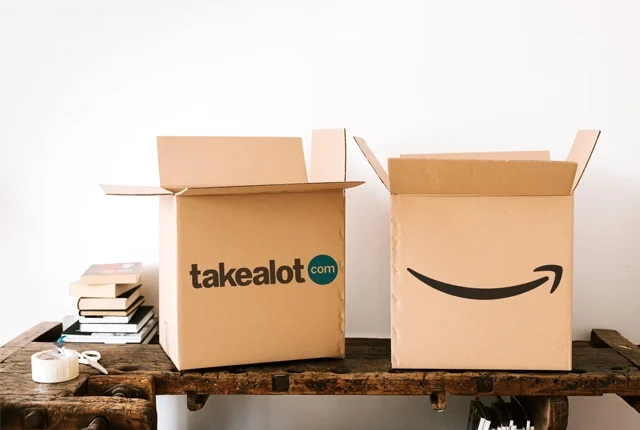
Amazon has spent the past year quietly but systematically deepening its South African footprint, expanding from a product range of 22 categories at launch to 28, growing its nationwide pickup network from 3,000 to more than 4,300 points, and introducing timed delivery slots across Johannesburg, Pretoria, and Cape Town. The escalation places South Africa’s decade-old e-commerce duopoly under direct and intensifying pressure, with Takealot now fighting on multiple fronts simultaneously.
Amazon.co.za went live on May 7, 2024. Robert Koen, Amazon’s managing director for Sub-Saharan Africa, described the launch as “only the start,” pledging to improve the experience continually. What has followed has proven that pledge credible.
In June 2025, Amazon entered the grocery and everyday consumables market by launching an “Everyday Essentials” category, adding non-perishable foods, pet food, vitamins, and health supplements to its local platform. Koen said at the time that groceries, pet supplies, and health supplements had been the most consistent requests from South African shoppers. Philile Mabolloane, retail head for consumables at Amazon South Africa, said the new selection had been curated specifically around the needs of South African families.
By November 2025, Amazon pushed further. It launched a Multiple-Delivery Windows service in Johannesburg, Pretoria, and Cape Town, giving shoppers the ability to schedule their deliveries up to one day in advance across three specific time bands: morning (08:00 to 13:00), afternoon (13:00 to 18:00), and evening (17:00 to 20:00). The service is priced at R2 per delivery slot with no minimum order requirement.
That same month, Amazon announced the expansion of same-day and next-day delivery to KwaZulu-Natal, including Durban and surrounding areas, in time for the festive shopping season. Orders placed by 14:00 qualify for delivery by 20:00 on eligible products.
Why it matters
South Africa’s online retail market was valued at approximately R200 billion in 2024 and is forecast to grow at a compound annual rate of 12.5% through 2030, according to market intelligence firm Mordor Intelligence. That growth trajectory has drawn global competition at scale: Amazon, Shein, and Temu have all entered the South African market in recent years, each targeting a consumer base that is increasingly comfortable shopping online but still sensitive to delivery reliability and pricing.
For South African shoppers, the intensifying competition is producing concrete benefits. Timed delivery windows, same-day delivery expanding beyond Johannesburg and Cape Town, and Amazon’s entry into grocery categories previously dominated by Takealot’s Mr D and rapid-delivery services like Checkers Sixty60 are directly reshaping expectations around what e-commerce should deliver.
For Takealot, the challenge is existential in a structural sense. The platform spent its early years building the infrastructure and consumer habits that made online shopping mainstream in South Africa. Amazon is now using that established consumer demand while competing directly on the features that Takealot built its reputation on: broad product selection, fast delivery, and loyalty incentives.
The Competition Commission complicated matters further. A 2023 ruling required Takealot to formally separate its marketplace and retail arms and remove restrictive pricing clauses that had previously prevented third-party sellers from offering lower prices on competing platforms. The structural change levelled the competitive landscape at precisely the moment Amazon arrived to take advantage of it.
Key details and figures
Takealot’s financial performance heading into this battle is stronger than at any point in the platform’s 15-year history, but the numbers also illustrate the cost of competing at this level.
According to Naspers’ annual results for the financial year ending March 31, 2025, Takealot Group generated revenue of $872 million, a 15% increase in local currency terms. Takealot.com, the group’s core general merchandise platform and Amazon’s direct competitor, saw gross merchandise value climb 13%, revenue increase 17%, and order volumes rise 15%. Despite those growth numbers, the group posted an adjusted earnings before interest and tax loss of $13 million for that period.
Naspers Group CFO Nico Marais told Reuters that Takealot’s performance had exceeded internal expectations. He added that Amazon had moved into the South African market at a slower pace than Naspers originally anticipated, which had given Takealot time to prepare. “We are ready to fight off competition,” Marais said.
Naspers’ interim results for the six months ending September 30, 2025 showed the momentum accelerating. Takealot.com recorded order growth of 16%, GMV growth of 17%, and revenue growth of 32% in that half-year period, reaching $385 million. Takealot CFO Tessa Ackermann confirmed at a media roundtable following those results that the company is on track to record its first full-year profit by the end of its 2026 financial year, with the October-to-December festive season expected to close the gap left by a loss of approximately R69 million in the first half.
Takealot has also responded to Amazon’s loyalty play. The platform launched TakealotMore, a subscription service offering free deliveries and collections, in May 2024, timed deliberately to coincide with Amazon’s market entry. Naspers noted in its results commentary that TakealotMore contributed to more frequent shopping behaviour and higher order volumes.
Amazon, meanwhile, has not disclosed specific South African sales figures. What it has confirmed is steady expansion: the grocery category launched with coffee, cereals, pasta, cooking oils, and canned goods among the top sellers, and the platform recorded “thousands of new local shoppers” each week through 2025, according to Amazon’s own statements.
What happens next
The competitive dynamic in South African e-commerce is unlikely to stabilise in the near term. Amazon has stated publicly, through Koen’s November 2025 comments, that it is “here for the long term” in the South African market. The global platform carries resources that no local competitor can match at scale: a logistics infrastructure refined over three decades, a global seller network, and the financial capacity to absorb losses in a new market for years.
Takealot’s near-term priority is closing out its first full-year profitable financial year. Ackermann indicated that the second half of FY2026 should deliver a significantly stronger performance than the first, driven by Black Friday and the festive period. Whether that profit materialises at the full-year level will be confirmed when Naspers reports its annual results, expected in mid-2026.
The category where the battle is sharpening most visibly is groceries and everyday essentials. Amazon’s move into non-perishables places it in direct competition not only with Takealot but also with established rapid-delivery operations. Whether Amazon expands into fresh produce in South Africa will be a significant signal of how aggressively it intends to compete beyond its current product scope.
For South African consumers and the thousands of small and medium-sized businesses that sell through both platforms, the outcome of this battle will determine pricing, delivery speeds, and access to markets for years. What is clear now is that Amazon is no longer testing the South African market. It is building for it.