





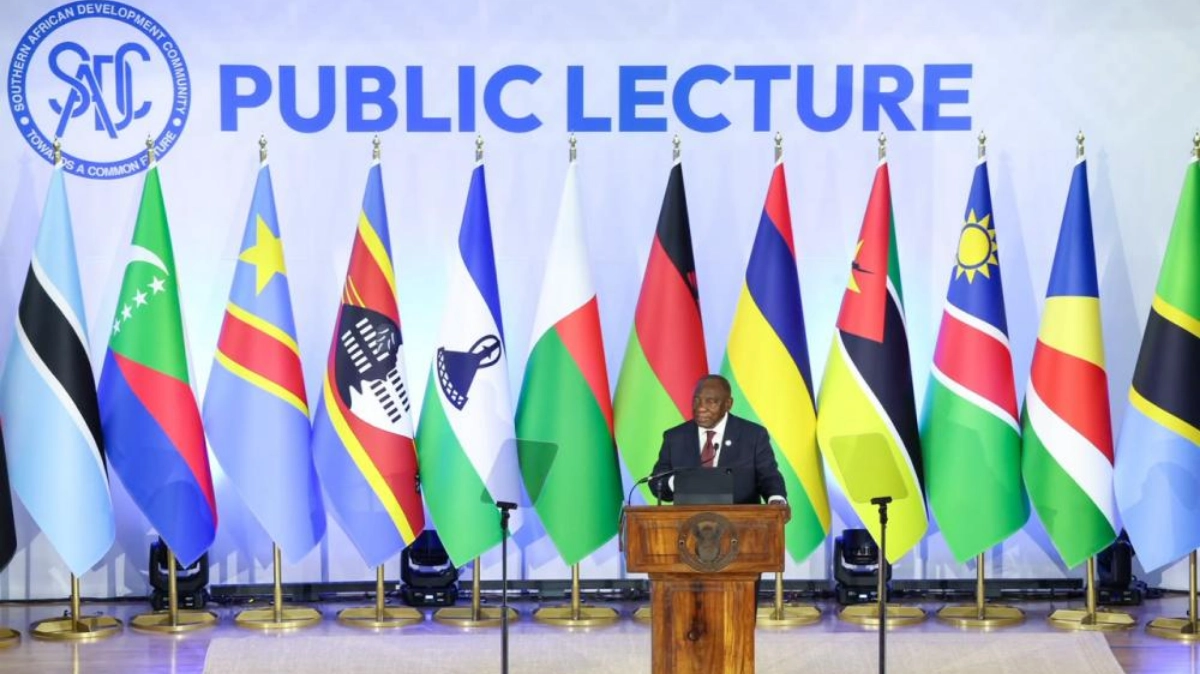
South Africa SADC chair duties began on Monday, 17 August 2026, when President Cyril Ramaphosa accepted the chairpersonship of the Southern African Development Community at the 46th Ordinary Summit of Heads of State and Government in Durban. South Africa now leads the 16-member bloc for the 2026/27 term. The summit theme places infrastructure, agriculture and critical minerals at the centre of the regional agenda. Outside the venue, anti-immigration protesters made clear that the region’s most contested question was not on the official programme.
South Africa’s SADC chairship at a glance
| Item | Detail |
|---|---|
| Summit | 46th Ordinary Summit of SADC Heads of State and Government |
| Date and venue | 16 and 17 August 2026, Inkosi Albert Luthuli International Convention Centre, Durban |
| Chair assumed by | President Cyril Ramaphosa |
| Handed over by | Zimbabwean President Emmerson Mnangagwa |
| Term | 2026/27, until the 47th Ordinary Summit in August 2027 |
| Member states | 16 |
| Theme | Resilient, sustainable and inclusive industrialisation through infrastructure development, agricultural and critical minerals transformation in pursuit of a just world |
| Security organ chair | Passed from Malawi to Eswatini on 16 August 2026 |
South Africa last chaired SADC in 2017. The bloc’s Secretariat and the Government Communication and Information System are the official sources for summit decisions.
Why the handover came from Zimbabwe
This detail confused a lot of coverage. Madagascar’s Andry Rajoelina took the chair at the 45th summit in Antananarivo in August 2025. After the political developments that removed him from office, Madagascar relinquished the role, and South Africa, as deputy chair, assumed interim leadership from a virtual extraordinary summit on 7 November 2025.
The formal handover in Durban was nonetheless recorded as coming from President Mnangagwa. That is what the Presidency and the Government Communication and Information System reported on the day.
What the chairship actually gives South Africa
Less power than the title suggests. SADC operates by consensus, and the chair sets the agenda and convenes summits rather than directing member states. Ramaphosa said South Africa would work with all member states while respecting sovereign equality, mutual respect and consensus building.
What the chair does control is emphasis. South Africa has signalled it will push the SADC Regional Indicative Strategic Development Plan and Vision 2050, the bloc’s long-term goal of becoming a competitive, middle to high income industrialised region.
In his opening address, Ramaphosa acknowledged that progress had been made through the SADC Free Trade Area, the SADC Real-Time Gross Settlement System and the Southern African Power Pool, but said the pace of transformation remained too slow. The bloc represents a combined market of more than 400 million people that its own members trade across relatively little.
He closed with the line that framed the summit: “Let us turn our borders into bridges.”
The minerals push
The clearest economic ask from Durban was beneficiation, meaning processing minerals into higher value products on the continent rather than exporting raw ore. Cobalt, copper, lithium, platinum group metals and manganese are all concentrated in the SADC region, and the bulk of the value is currently added elsewhere.
This is not a new demand, and that is precisely the problem. Beneficiation has appeared in SADC communiqués for years without the smelters, refineries and reliable power to make it real. South Africa’s own position is set out in more detail in our coverage of the national critical minerals strategy.
The push also lands in a difficult trade year. South African exporters are absorbing new United States tariffs, examined in our reporting on the 12.5% tariff on South African goods, while duty-free access under the African Growth and Opportunity Act remains subject to a pending extension. Regional processing capacity is a long-term answer to a problem that is immediate.
The migration contradiction outside the door
March and March protesters gathered outside the convention centre on 17 August, demanding action on illegal immigration. The Presidency’s spokesperson said the demonstrations would have no bearing on the leaders’ discussions.
The tension is real regardless. Ramaphosa has argued that the region should address the conditions that drive people to leave their countries rather than relying on enforcement alone, while linking stability and development directly. “Peace without development is fragile,” he said.
South Africa is simultaneously the destination for most regional migration and the country where the domestic politics of that migration are hardest. A chair calling for borders to become bridges while hosting protests demanding the opposite is the defining awkwardness of this chairship.
Free movement remains stuck
The SADC Protocol on the Facilitation of Movement of Persons was adopted in 2005 and has still not entered into force. Entry into force requires ratification by two thirds of member states, which means 11 of the 16.
Reported figures put signatures at 10 and ratifications at 7 as of mid-2026. Signature is not ratification, and only ratifications count. Confirm the current count with the SADC Secretariat before relying on it, as ratifications are deposited periodically and the tally changes.
Twenty-one years without entry into force is the clearest measure of the gap between SADC declarations and SADC delivery, and it is the gap Ramaphosa himself named when he said communiqués must become construction sites, factories and power lines.
Questions readers are asking
How long is South Africa the SADC chair?
One year, until the 47th Ordinary Summit in August 2027.
Which countries are in SADC?
Sixteen: Angola, Botswana, Comoros, the Democratic Republic of Congo, Eswatini, Lesotho, Madagascar, Malawi, Mauritius, Mozambique, Namibia, Seychelles, South Africa, Tanzania, Zambia and Zimbabwe.
Does the SADC chairship change visa rules for South Africans?
No. Visa and immigration rules are set by each member state. The free movement protocol is not in force.
Where was the 2026 SADC summit held?
The Inkosi Albert Luthuli International Convention Centre in Durban, previously known as the Durban International Convention Centre.
Who chairs the SADC security organ?
Eswatini, which took over from Malawi on 16 August 2026. The organ chair rotates separately from the summit chair.
Is Madagascar still a SADC member?
Yes. It relinquished the chair, not its membership, and a panel of SADC elders led by former Malawian president Joyce Banda is handling the political situation there.
What to watch
The summit communiqué is the document that matters, since it records the actual decisions rather than the speeches, and it is published by the SADC Secretariat. Watch for whether the SADC Regional Development Fund is operationalised, since the bloc has no functioning project finance vehicle and every industrialisation commitment depends on one. Watch the ratification count on the free movement protocol, which needs four more countries. And watch whether South Africa uses the chair to convene anything on Madagascar or the eastern Democratic Republic of Congo, which are the two files most likely to test a chairship built on an economic agenda.