






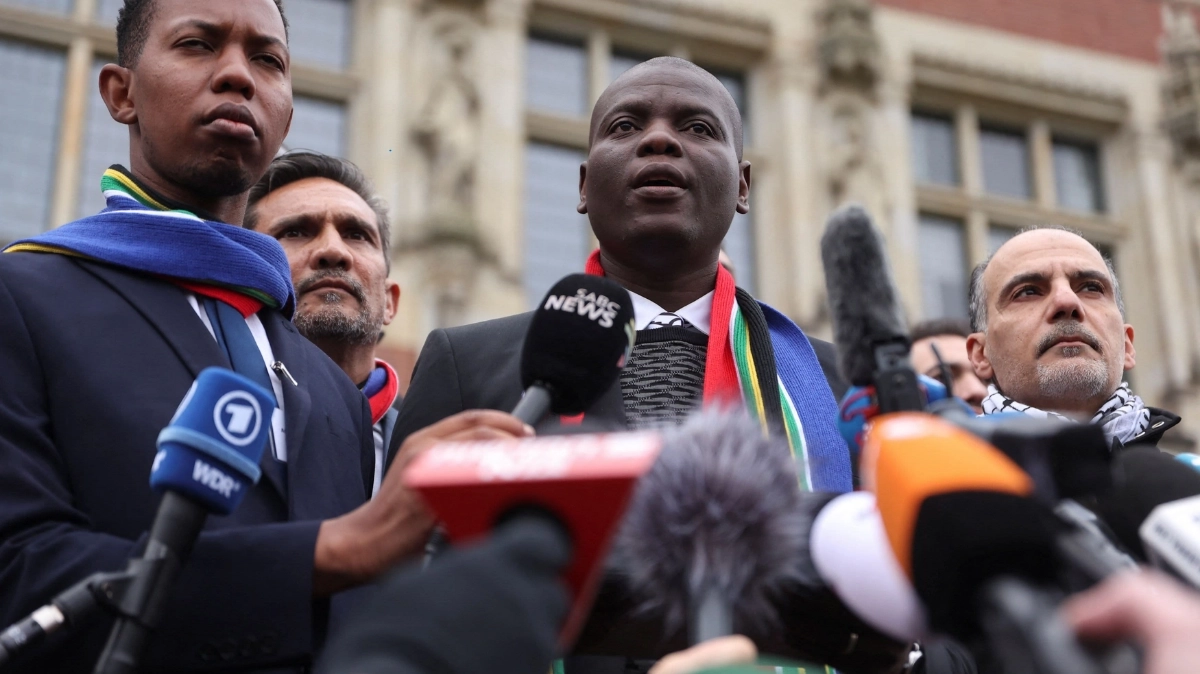
South Africa has filed a fresh dossier with the International Court of Justice alleging that Israel is not complying with three binding orders, and the reason it did so is that the South Africa ICJ case will not produce a final judgment for years yet.
The Department of International Relations and Cooperation said on Friday that the dossier was submitted to the court on 25 August 2026.
The court’s own timetable puts the filing in context. On 21 May 2026 the ICJ fixed 22 November 2027 as the deadline for South Africa’s Reply and 22 May 2029 for Israel’s Rejoinder.
Counting from 29 December 2023, when South Africa instituted proceedings, that is more than five years and four months of written argument before a single day of oral hearings. The order was signed by the president of the court, Judge Iwasawa Yuji, and its registrar, Philippe Gautier.
Until then, the only thing the court has imposed on Israel are the three provisional measures orders of January, March and May 2024. The dossier is about those, not about the genocide question itself.
What the dossier can and cannot do
The submission was made under Article 11 of the court’s rules on internal judicial practice, which provides for a committee of judges to examine information supplied by the parties about provisional measures.
That committee monitors implementation and can recommend options. It does not rule. Decisions rest with the full bench of 15 judges.
Dirco did not say what action it wants the committee to recommend, did not state the dossier’s length, and did not identify the documents in it. The committee’s work is not public.
The court also has no enforcement arm of its own. Under the United Nations Charter, a state that considers another has failed to perform obligations under a judgment may take the matter to the Security Council, where each of the five permanent members holds a veto.
Five earlier dossiers went to politicians, this one went to judges
Dirco’s statement lists the department’s previous evidence submissions. Three public dossiers went to the UN Security Council, on 29 May 2024, 27 February 2025 and 8 September 2025. Further dossiers on starvation went to the UN General Assembly and the Economic and Social Council in October 2025, requesting action under Article VIII of the Genocide Convention.
Every one of those went to a political organ of the UN. The 25 August filing went to the bench.
| Date | Step in the case |
|---|---|
| 29 December 2023 | South Africa institutes proceedings under the Genocide Convention |
| 26 January 2024 | First provisional measures order |
| 28 March 2024 | Second provisional measures order |
| 24 May 2024 | Third provisional measures order |
| 29 May 2024 | First evidence dossier sent to the UN Security Council |
| 28 October 2024 | South Africa files its Memorial |
| 27 February 2025 | Second dossier to the UN Security Council |
| 8 September 2025 | Third dossier to the UN Security Council |
| October 2025 | Starvation dossiers to the UN General Assembly and ECOSOC |
| 12 March 2026 | Israel files its Counter-Memorial and objects to the court’s jurisdiction |
| 21 May 2026 | Court fixes 22 November 2027 and 22 May 2029 for the remaining pleadings |
| 25 August 2026 | Dossier submitted to the ICJ committee of judges |
Thirty-two months have passed since the first provisional measures order. Dirco’s position is that none of the three has been honoured. “Regrettably, Israel has not complied with the Orders,” the department said.
What the South Africa ICJ case has and has not established
The distinction matters and is often lost. The ICJ has made no finding that genocide has been committed. That question is the subject of the merits proceedings still running to 2029 and beyond.
What the court did find, when it granted provisional measures, is that Palestinians in Gaza have plausible rights to protection under the Genocide Convention and face a real and imminent risk of irreparable prejudice to those rights. That is a threshold for interim protection, not a verdict.
The figures in Friday’s statement are the department’s own assertions. Dirco cited at least 73 407 Palestinians killed and 174 335 injured in Gaza since 7 October 2023, and an estimated 46 000 survivors living with severe conflict-related injuries including amputations and traumatic brain and spinal cord injuries. It also alleged that Palestinian miscarriage rates in Gaza have more than tripled in 2026, and that Israel has killed local journalists and barred foreign journalists and UN-mandated investigative bodies from entering.
Unicef’s regional director for the Middle East and North Africa, Edouard Beigbeder, said on 6 August that a ceasefire under which a child is still killed on average every day is not protecting children.
Israel rejects the genocide allegation and maintains that its military operations target Hamas and other armed groups. In its Counter-Memorial filed on 12 March 2026 it objected to the court’s jurisdiction and to the admissibility of South Africa’s application. It also argued to the court that a second round of written pleadings was unnecessary. No Israeli response to this particular dossier could be traced.
What is still unresolved
Several things remain unconfirmed. Dirco has not said what remedy it is seeking from the committee, the committee’s timetable for reporting to the full court is not public, and there is no published mechanism obliging the court to act on the dossier at all. The casualty figures are Dirco’s, drawn from Gaza health ministry totals, and could not be independently verified for this report.
South Africa’s Reply is due on 22 November 2027 and must also answer Israel’s jurisdictional objections, according to the Presidency. The Presidency has separately noted that a second round of written pleadings has been permitted in every previous Genocide Convention case brought to the court.
Pretoria has tied the case to a broader argument about multilateral institutions, made while South Africa holds the SADC chair for 2026 and 2027. Southafriworld has previously reported on the ICJ petition involving South Africa.
Oral hearings cannot be scheduled until the written phase closes in May 2029. No date has been set.